What does bolero mean?
Bolero is a noun with two principal meanings that share a single Spanish origin. Its oldest sense denotes a lively Spanish dance in triple time, traditionally danced by a couple to the accompaniment of castanets and guitar; by extension, 'bolero' also names music written in that style, most famously Maurice Ravel's 1928 orchestral work 'Boléro', whose relentless repeated melody has made it one of the best-known pieces in the classical repertoire. In modern English, particularly in fashion, bolero more often refers to a short, open-front jacket that finishes at or just above the waist, worn over dresses or tops as a light covering for the shoulders and arms. The plural is simply 'boleros'. The word carries connotations of elegance and romance in both its senses — the passionate choreography of the dance and the graceful lines of the garment. Whether describing footwork on a stage or tailoring on a runway, bolero reliably evokes Spanish flair.
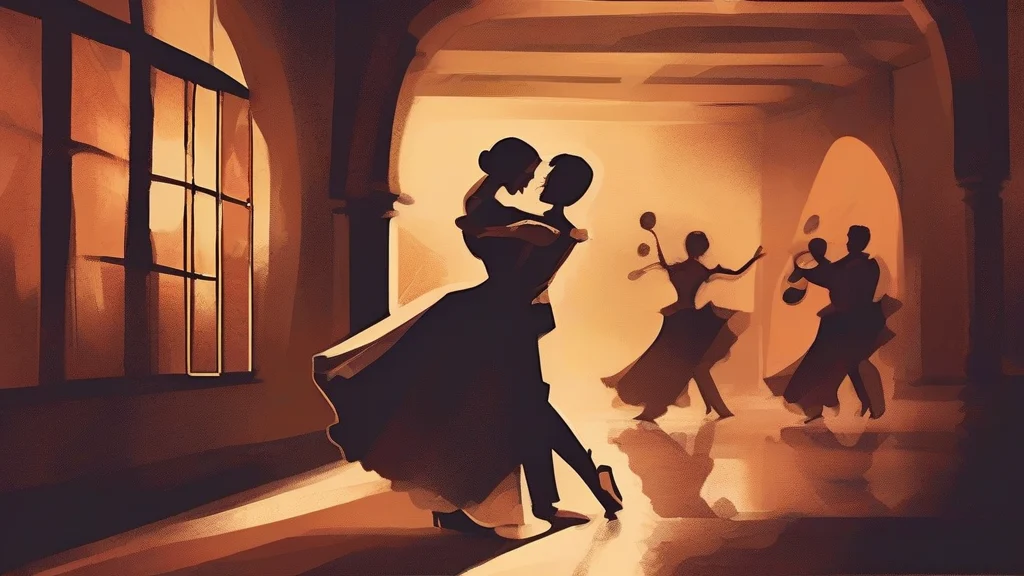
A lively Spanish dance in triple time, traditionally performed by a couple with castanets.
"They rehearsed the bolero for weeks before the festival performance."
A piece of music written in the style of the bolero dance, especially Ravel's celebrated 1928 composition.
"The orchestra closed the concert with Ravel's Boléro."
A short, open-front jacket ending at or just above the waist, worn by women over a dress or top.
"Her wedding dress came with a delicate lace bolero."
Standard English plural, formed by adding -s; applies to both the jacket and to pieces of music in bolero style.
"The boutique stocks silk boleros in several colours."
Maurice Ravel's 'Boléro' was meant to be background music for a factory — it became one of the most performed orchestral works ever written.
Reviewed by Deb Chak, Editor. AI-assisted content curated by RJS Tech Solutions LLP.
Etymology of bolero
Bolero comes directly from Spanish, where it names the traditional dance; the word's ultimate derivation within Spanish is uncertain, though it has been connected to 'bola' (ball). The dance itself developed in Spain in the late 18th century. The fashion sense arose later, named after the cropped jackets worn by dancers performing the bolero, and entered English during the 19th century.
Related word forms
How bolero is actually used
In British English the dance sense is often stressed on the first syllable (/ˈbɒl.ə.rəʊ/), while American English typically stresses the second syllable (/bəˈlɛr.oʊ/), matching the Spanish source. The jacket sense is common in fashion contexts, where 'bolero' alone usually implies the cropped garment; the phrase 'bolero jacket' is used when clarity is needed.
Easily confused with bolero
A ballerino is a male ballet dancer, whereas a bolero is a Spanish dance form in triple time (or the music or short jacket associated with it).