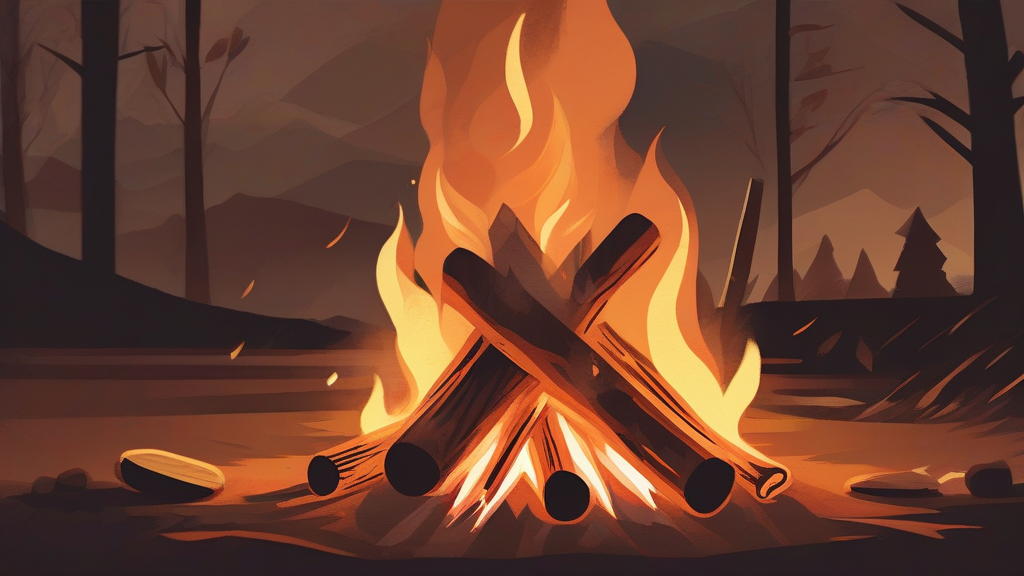
What does bonfire mean?
A bonfire is a large, deliberately built outdoor fire, typically lit to mark a celebration or festival, to burn waste such as garden debris, or simply to provide warmth and a focal point for a gathering. Unlike a small campfire, which is chiefly practical, a bonfire is usually a substantial structure of wood, often stacked high, and its glow can be seen from a distance. The word carries warm connotations of community: people cluster around bonfires to talk, sing, watch effigies burn, or celebrate seasonal traditions such as Britain's Bonfire Night on 5 November, held in memory of the failed Gunpowder Plot of 1605. Etymologically intriguing, 'bonfire' derives from an older English term 'bonefire', meaning a fire in which bones were burned, later reshaped under French influence into its modern form. Today it remains a vivid, evocative word tied to festivity, ritual, and the simple pleasure of a shared flame.
nounA large outdoor fire, typically built for burning rubbish, celebrating an event or festival, or providing warmth and light at a gathering.
- A large open-air fire lit for celebration, ceremony, or festival (e.g. Bonfire Night, midsummer festivals).
- A large fire built outdoors for burning rubbish, leaves, or debris.
- Figurative use: a source of intense warmth, light, or communal gathering.
"The villagers gathered around the bonfire to celebrate Guy Fawkes Night."
"Crowds cheered as the towering bonfire finally caught light on the cold November night."
"After clearing the garden, they burned the fallen branches in a bonfire at the edge of the field."
Standard regular plural.
"Bonfires blazed across the country on the fifth of November."
The word 'bonfire' literally began as 'bone-fire' — a fire made of bones — before the 'bone' was smoothed into 'bon' by French influence.
Reviewed by Deb Chak, Editor. AI-assisted content curated by RJS Tech Solutions LLP.
Etymology of bonfire
Bonfire originated in Middle English as 'banefire' or 'bonefire', literally a fire used for burning bones, attested from around the fifteenth century. Over time the initial element was altered, likely by association with French 'bon' ('good'), yielding the modern form 'bonfire'. The word's sense broadened from fires that disposed of bones to any large celebratory open-air blaze, including those lit for events like Guy Fawkes Night. It has no direct foreign cognates, being an English formation whose components were reshaped within English itself.
How bonfire is actually used
In Britain, 'bonfire' carries strong associations with Bonfire Night (5 November), marking the failed Gunpowder Plot of 1605; in North America it more often suggests casual gatherings, festivals, or the burning of yard waste. The word is informal-to-neutral in register and always implies a fire that is deliberately built and substantial in size.
Easily confused with bonfire
A campfire is a small fire used for cooking or warmth while camping, whereas a bonfire is a large open-air fire built as part of a celebration, ceremony, or for burning waste.