
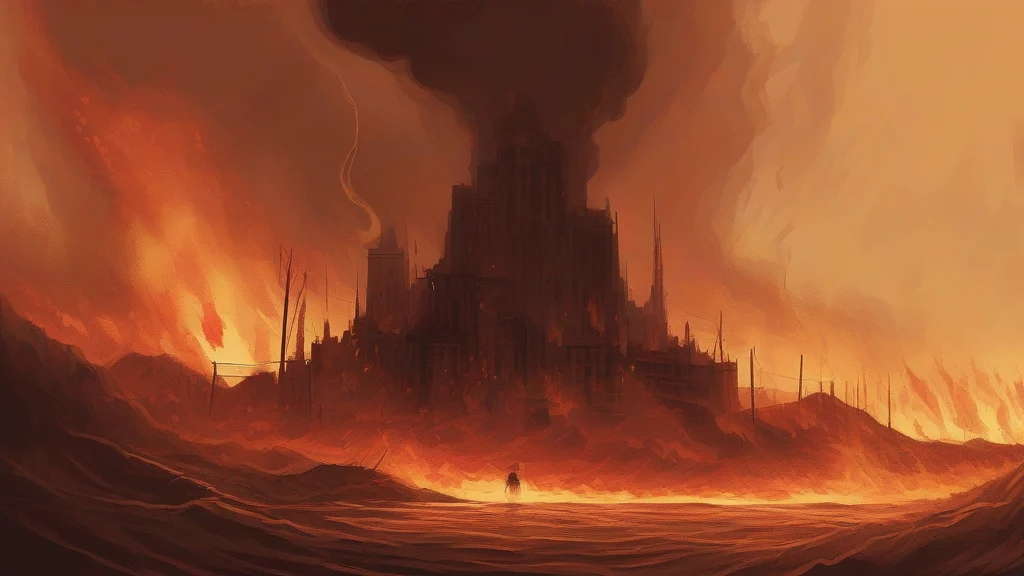
What does inferno mean?
An inferno is an exceptionally intense fire, or a place consumed by one. The word also describes situations marked by extreme heat, violence, confusion, or disorder, as in a battle that became an inferno or a city transformed by an inferno of flames. Its dramatic force comes from the idea of a blaze so powerful that it dominates everything around it. Although it can refer literally to fire, it is especially common in figurative expressions describing overwhelming events, heated arguments, or chaotic circumstances. The word entered English from Italian, where Dante’s Divine Comedy made “Inferno” the enduring name for the first part of Hell. Today it is used in both ordinary and literary contexts, generally where the intensity is genuinely noteworthy.
An intensely burning fire, or a place filled with such a fire.
"The wildfire created a vast inferno across the mountainside."
The literal sense is often used in descriptions of fires, explosions, and other extreme heat.
A situation characterized by extreme confusion, violence, heat, or disorder.
"The city was an inferno after the earthquake."
This figurative use is common in journalism and literary writing and carries a strongly dramatic tone.
The plural is infernos, used when referring to separate fires or figurative situations.
"The novel describes several infernos that consume the characters' lives."
The word became famous through Dante’s Divine Comedy, whose first part is titled Inferno and describes the levels of Hell.
Reviewed by Deb Chak, Editor. AI-assisted content curated by RJS Tech Solutions LLP.
Where does inferno come from?
The English word comes from Italian inferno, meaning “hell” or “inferno,” and ultimately from Latin infernus, meaning “infernal,” “lower,” or “beneath.” Dante used the title Inferno for the first part of his Divine Comedy, describing Hell as a series of progressively deeper circles. English borrowed the Italian form and gradually extended its figurative sense to mean any overwhelming fire or violent, chaotic situation.
How inferno is actually used
The expression is strongly figurative when describing chaos, conflict, or overwhelming circumstances. It can sound dramatic or literary, so it is less appropriate for minor difficulties.
Easily confused with inferno
An inferno is a fire or a figurative situation of extreme heat or turmoil, whereas infernal is an adjective meaning hellish or extremely unpleasant.