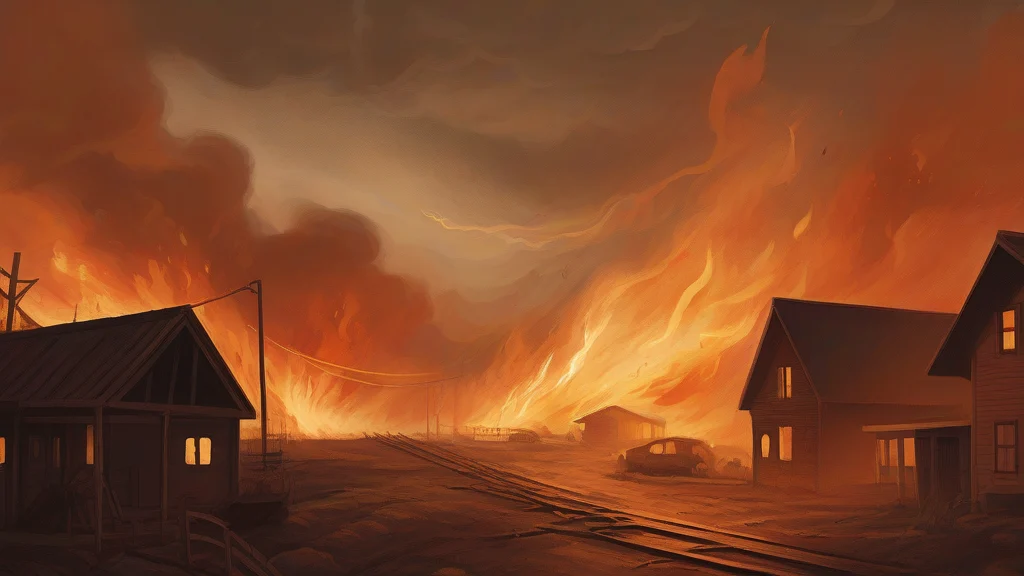
What does firestorm mean?
A firestorm is, in its original sense, a fire of extraordinary intensity — one so large and hot that the rising column of heated air pulls in surrounding winds, feeding the flames and driving them to spread with terrifying speed. The term entered wide use through descriptions of catastrophic urban fires and wartime bombing, such as the firestorms that destroyed Hamburg and Dresden in the Second World War. In modern usage, however, the word is most often applied figuratively: a political scandal, an inflammatory statement, or a controversial decision is said to ignite a 'firestorm' of criticism when it provokes sudden, widespread public outrage. This metaphorical sense dominates contemporary journalism and everyday conversation. The word's power lies in its imagery — like the meteorological phenomenon it names, a figurative firestorm suggests something uncontrollable, all-consuming, and dangerous, which makes it a vivid and frequently deployed term for describing eruptions of anger and controversy in public life.
nounA very intense, widespread fire that generates its own wind system and is capable of spreading rapidly; by extension, a sudden outburst of intense public controversy or criticism.
- A massive, intensely hot fire in which rising hot air draws in surrounding winds, causing the flames to spread with extreme speed and violence.
- An intense, sudden public controversy or uproar, typically involving heated criticism or outrage.
"The prime minister's offhand remark ignited a media firestorm within hours."
"The bombing raids of the Second World War created firestorms that devastated entire city districts."
"Her comments set off a firestorm on social media that lasted for days."
Standard plural; used for both literal fires and multiple controversies.
"The war produced firestorms in several major cities, each more devastating than the last."
Real firestorms can generate hurricane-force winds and temperatures hot enough to melt glass — which is why the word was borrowed to describe scandals that rage just as uncontrollably.
Reviewed by Deb Chak, Editor. AI-assisted content curated by RJS Tech Solutions LLP.
Etymology of firestorm
Firestorm is a compound of two native Germanic words, 'fire' and 'storm', both inherited from Old English and ultimately from common Germanic roots. The compound emerged in the early twentieth century, as military planners and journalists sought a name for the self-sustaining mega-fires produced by aerial bombardment and mass urban conflagrations. Its figurative extension to describe storms of public outrage developed soon afterwards, particularly in American journalistic usage. The element 'fire' shares a distant Indo-European root with Greek 'pyr', seen in words like 'pyre'.
How firestorm is actually used
The literal sense is largely confined to descriptions of catastrophic fires, especially historical accounts of wartime bombing and major urban blazes. The figurative sense — an explosion of public outrage — is now far more common in journalism and everyday speech, and carries a strongly dramatic, negative connotation. It is standard in formal news writing as well as informal commentary.
Easily confused with firestorm
A backlash is any strong adverse reaction, while a firestorm implies an especially intense, explosive, and often public controversy.
Wildfire refers to an uncontrolled rural or forest fire, whereas a firestorm specifically denotes a blaze so fierce it creates its own winds, or metaphorically a storm of outrage.