What does bonsai mean?
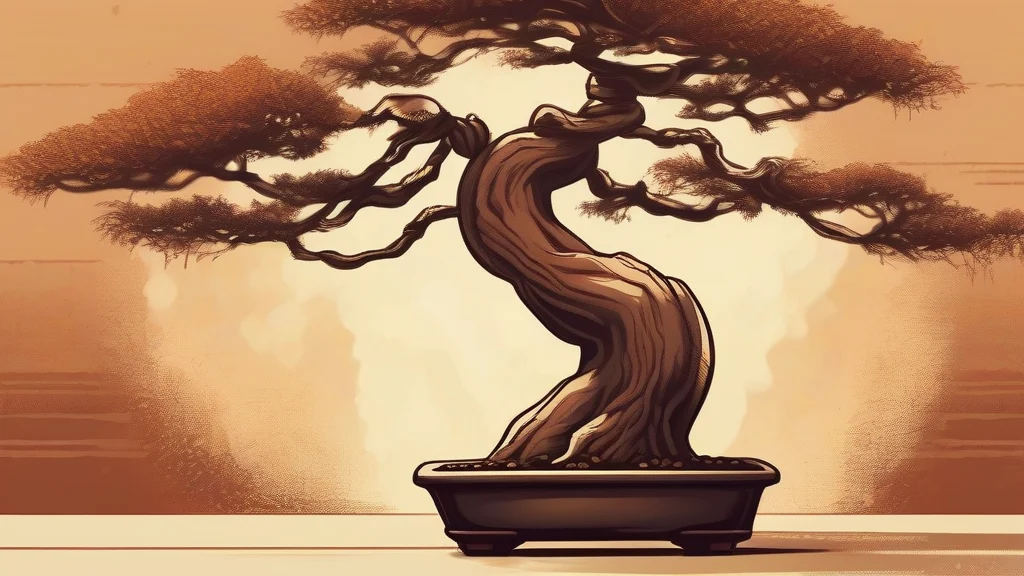
Bonsai refers to a tree or shrub that has been deliberately kept miniature by growing it in a shallow container and carefully pruning its branches and roots. Originating from ancient Chinese practices and refined into a distinctive art form in Japan over many centuries, bonsai is not simply a small plant but a living sculpture shaped over years—or even generations—to evoke the appearance of a mature tree in nature. The term also denotes the practice itself: the patient, disciplined craft of training such trees. Because both the singular and the plural are identical, one speaks of a single bonsai or a collection of bonsai. In English usage the word carries strong connotations of tranquility, dedication, and reverence for nature, and it is frequently encountered in gardening, interior design, and discussions of East Asian aesthetics.
A tree or shrub grown in a shallow pot and kept deliberately small through pruning and root-trimming, cultivated as an art form.
"The museum's collection includes a bonsai believed to be over four hundred years old."
The plural is identical to the singular: several trees are referred to as bonsai, not 'bonsais.'
The art or practice of cultivating such miniature trees.
"He has practiced bonsai for thirty years, exhibiting at shows across the country."
The plural is the same as the singular; do not add -s. Collections are described as 'a number of bonsai' or simply 'bonsai.'
"The exhibition displayed dozens of bonsai, each centuries old."
Some bonsai trees alive today have been trained for centuries—passed down through generations longer than many nations have existed.
Reviewed by Deb Chak, Editor. AI-assisted content curated by RJS Tech Solutions LLP.
Etymology of bonsai
Bonsai is borrowed directly from Japanese, where it is written with characters meaning 'tray' (bon) and 'planting' (sai), literally 'tray planting.' The underlying technique traces back to ancient China, where dwarfed potted trees known as penjing were cultivated, and was adopted and developed into its modern form in Japan between roughly the twelfth and seventeenth centuries. The word entered Western languages, including English, in the twentieth century as Japanese horticultural arts gained international audiences. It shares its Chinese origins with related terms for container-grown landscapes rather than any Latin or Greek root.
How bonsai is actually used
Both singular and plural take the same form: one bonsai, several bonsai. The stress falls on the first syllable in British English, while American speakers often stress the second syllable. The word carries connotations of patience, precision, and contemplative care.
Easily confused with bonsai
Bonzai-style 'banzai' is the Japanese cheer meaning 'ten thousand years,' shouted in celebration or battle, whereas bonsai is the art of growing dwarfed potted trees.