What does booger mean?
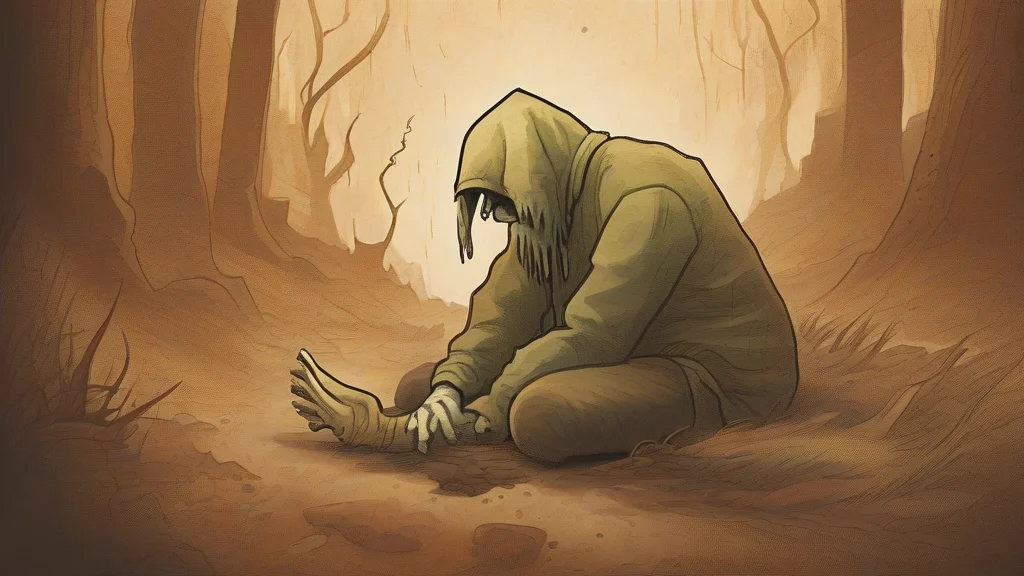
A booger is a small piece of dried mucus from the nose — a substance everyone produces but almost no one discusses in polite company. The word belongs firmly to informal, often juvenile register: children talk about picking boogers, adults tend to use more clinical terms such as 'nasal mucus'. Though primarily North American, the term has spread widely through popular culture. Intriguingly, 'booger' has a second, older life in regional American English, particularly in the South and Appalachia, where it names a frightening spirit or hobgoblin — a cousin of the bogeyman used to keep children indoors at night. This dual identity makes the word a small linguistic curiosity: the same syllables can describe something trivially unhygienic or something genuinely eerie. Its etymology connects it to a whole family of words for imaginary terrors, including 'bogey', 'bugbear', and 'bugaboo', all descended from old words for goblins and frights.
A small piece of dried nasal mucus.
"She discreetly removed a booger from her son's nose before the school photo."
Informal; chiefly US and Canadian. Avoided in medical or formal writing, where 'dried nasal mucus' is preferred.
A frightening phantom or hobgoblin, especially one invoked to scare children.
"Grandpa always said the booger lived down by the creek and only bothered naughty kids."
Regional to the American South and Appalachia; increasingly rare outside folklore discussions.
Standard plural; used for both the mucus sense and, regionally, the folklore sense.
"The kindergartners were sent to wash their hands after a lesson on why we don't eat boogers."
The word 'booger' shares its ancient family tree with the bogeyman — both trace back to an old word for something scary lurking up your nose... or under your bed.
Reviewed by Deb Chak, Editor. AI-assisted content curated by RJS Tech Solutions LLP.
Etymology of booger
'Booger' derives from older English dialect words for goblin-like creatures, sharing a root with 'bogey' and 'bogeyman'; these trace to Middle English 'bogge' or 'bugge', meaning a frightening specter, which also gave rise to 'bugbear' and 'bugaboo'. The mucus sense arose by extension in American English, where the creature-name came to be applied humorously to the dried nasal lump. The folklore sense remains strongest in Southern and Appalachian speech, while the mucus sense dominates elsewhere.
How booger is actually used
Informal and colloquial, chiefly North American; the equivalent British colloquialism is 'bogey' or 'snot'. The word carries a childish, mildly gross connotation and is avoided in formal contexts. The folklore sense ('a booger' as a spook) survives mainly in the American South and Appalachia.
Easily confused with booger
A bogey is a golf score of one stroke over par (or a ghostly figure in British usage), while a booger is a piece of dried nasal mucus.
Bugger is a vulgar British term with unrelated sexual or exasperated meanings, whereas booger refers to dried mucus from the nose.