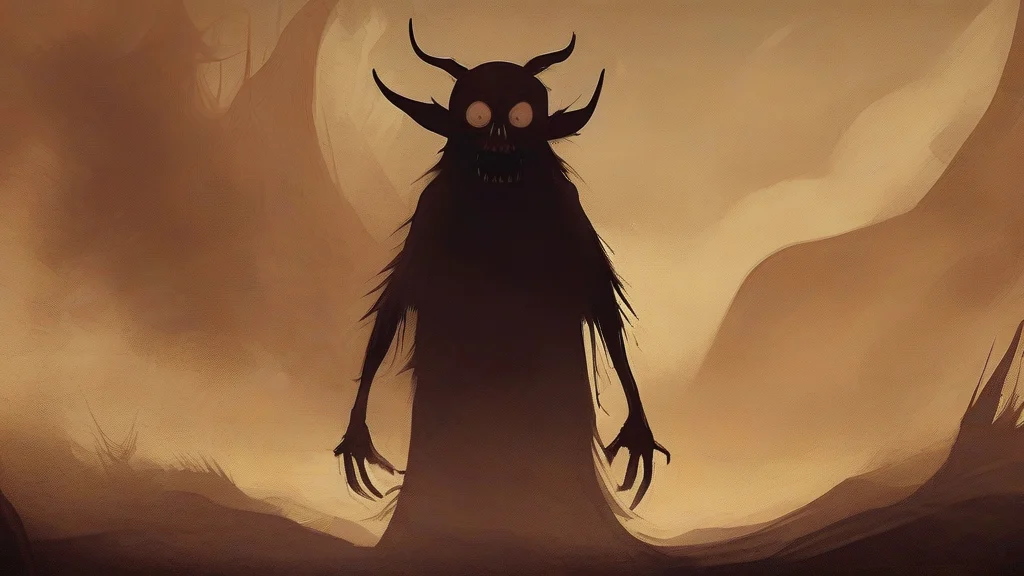
What does bogeyman mean?
The bogeyman is an imaginary monster or evil spirit whose chief role is to frighten children — traditionally invoked by parents and storytellers to discourage misbehavior, as in warnings that 'the bogeyman will get you' if a child stays up late or wanders off. Because the figure exists only in imagination, it has no fixed appearance and varies across cultures and households. Over time the term broadened into figurative use: a bogeyman can now be any person, group, or idea that is held up as a source of dread, particularly when that fear seems exaggerated or politically convenient. Journalists might describe a foreign power, an economic policy, or a rival company as 'the bogeyman' of an industry. The connotation is usually one of irrational or manufactured fear rather than genuine danger. Informal but widely understood across British and American English, the word is a useful shorthand for discussing how societies personify their anxieties.
An imaginary evil spirit or monster used to frighten children.
"She left the hallway light on so her son wouldn't worry about the bogeyman."
Often capitalized in folkloric contexts, though lowercase is standard in general use.
A person or thing regarded as a widespread object of fear or blame, especially one whose menace is exaggerated.
"Critics dismissed the report's central warning as nothing more than a bureaucratic bogeyman."
Common in political and journalistic writing, often implying manipulation of public fear.
The plural follows the irregular 'men' pattern of 'man.' 'Bogeymans' is not standard.
"Different cultures have their own bogeymen, from Japan's Namahage to Latin America's El Coco."
The word 'bogey' and the word 'bug' may share the same ancient root — the monsters under your bed and the bugs in your code are distant cousins.
Reviewed by Deb Chak, Editor. AI-assisted content curated by RJS Tech Solutions LLP.
Etymology of bogeyman
The word derives from 'bogey,' a Middle English term for a frightening spirit, which itself traces back through forms such as 'bugge' meaning a scarecrow or hobgoblin. It belongs to a family of related figures including the bugbear, the Scottish bogle, and the bugaboo, all names for imaginary terrors. The compound 'bogeyman' — the monster specifically conjured to menace children — became established in English usage by the early modern period. Intriguingly, some scholars connect this same root to the everyday word 'bug,' suggesting a shared lineage between imaginary goblins and the insects we still find unsettling.
Related word forms
How bogeyman is actually used
The word is informal to neutral and appears frequently in journalism and political rhetoric, where calling something 'a bogeyman' implies the fear of it is exaggerated or manipulated. The plural is normally 'bogeymen'; 'bogeymans' is nonstandard.
Easily confused with bogeyman
A bogie (or bogey) is a wheeled chassis under a train or a golf score of one over par, whereas the bogeyman is an imaginary monster used to frighten children.