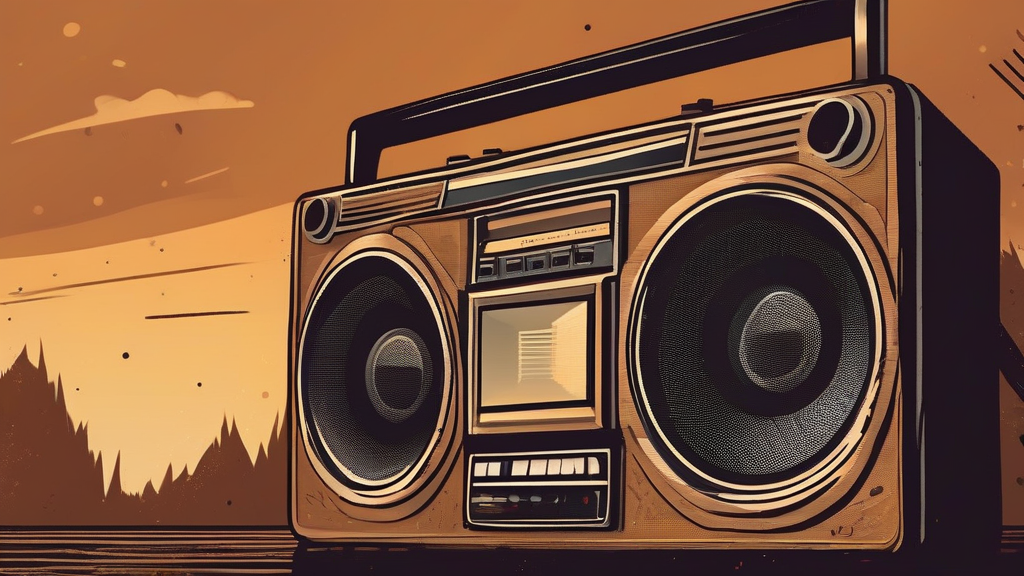
What does boombox mean?
A boombox is a large portable audio system — combining a radio, cassette or CD player, amplifier, and two or more loudspeakers in a single case — designed to play music loudly without being plugged into mains power. Typically powered by batteries and often fitted with a carrying handle, it emerged in the late 1970s and became a cultural icon of the 1980s, especially in urban America, where it was carried on the shoulder to public spaces, parks, and street corners. The word is informal but entirely neutral in register, and it carries strong connotations of nostalgia, youth culture, hip-hop, and breakdancing. In British English the same device was historically known as a 'ghetto blaster'. Although streaming and Bluetooth speakers have largely replaced it, 'boombox' survives as a vivid shorthand for bold, portable, old-school sound.
nounA large portable radio and cassette or CD player with two or more loudspeakers, typically carried on the shoulder, that plays music at high volume.
- A large portable stereo system with built-in loudspeakers, popular from the late 1970s onward, capable of playing music loudly without external power.
"He hoisted the boombox onto his shoulder and strutted down the street playing old-school hip-hop."
"She balanced the heavy boombox on one shoulder as she walked to the park."
"In the 1980s, a boombox blasting breakbeats became an icon of urban street culture."
Regular plural formed by adding -es because the compound ends in 'x' (pronounced /ks/).
"Several boomboxes competed for volume at the block party."
The boombox was so central to 1980s street culture that the film 'Do the Right Thing' made Radio Raheem's giant one a symbol of the whole era.
Reviewed by Deb Chak, Editor. AI-assisted content curated by RJS Tech Solutions LLP.
Etymology of boombox
Boombox is a twentieth-century English compound of 'boom' (a deep, resonant booming sound) and 'box' (a container or casing), coined to describe the loud, bass-heavy portable stereos that appeared in the late 1970s. It is a transparent descriptive formation rather than a borrowing, so it has no cognates in other languages beyond its component words. Its rise parallels the spread of portable cassette technology and hip-hop culture.
Related word forms
How boombox is actually used
Informal register. The term is chiefly North American; in Britain the equivalent device was commonly called a 'ghetto blaster', a term now widely considered dated or offensive in some contexts. 'Boombox' itself is neutral and nostalgic in tone today.