What does boracite mean?
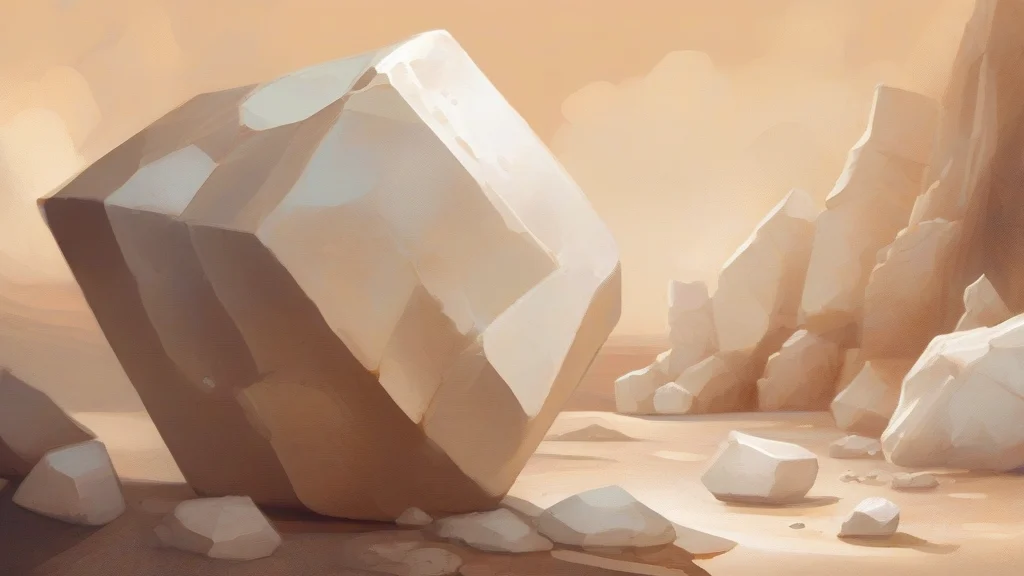
Boracite is a rare borate mineral composed of magnesium, boron, oxygen, and chlorine, with the chemical formula Mg₃B₇O₁₃Cl. It typically forms well-defined cubic or pseudo-cubic crystals that may be colourless, white, grey, or pale shades of green, blue, or yellow, and it occurs chiefly in evaporite deposits such as the famous salt beds at Stassfurt in Germany. The mineral is of particular scientific interest because it is both piezoelectric and pyroelectric, developing electrical charges across its surfaces when subjected to mechanical stress or temperature change — a property observed by natural philosophers long before such effects were formally understood. Boracite is encountered almost entirely within mineralogy, geology, and chemistry; collectors prize its sharp, glassy crystals, and museums often display fine specimens. Although never a household word, it offers a vivid example of how minerals from ordinary-looking salt deposits can exhibit remarkable physical behaviour.
nounA rare colourless, white, or pale-coloured borate mineral of magnesium and boron that crystallises in the cubic system and is typically found in evaporite deposits.
- A rare cubic crystalline borate mineral of magnesium (with some iron), Mg₃B₇O₁₃Cl, occurring in evaporite deposits and notable for its pyroelectric properties.
"The salt mine's seams yielded fine crystals of boracite alongside halite and anhydrite."
"The museum's mineral gallery displays a striking glassy cube of boracite from the Stassfurt salt deposits."
"Because boracite becomes electrically charged when heated, it attracted the attention of early researchers studying pyroelectricity."
Used as a countable plural when referring to individual specimens or occurrences of the mineral; more commonly treated as a mass noun when discussing the substance in general.
"The collection includes several fine boracites from evaporite deposits across Europe."
Boracite has a quirky party trick: it is pyroelectric, meaning it develops electric charges at opposite ends of a crystal when heated or cooled — a phenomenon noticed as early as the 18th century.
Reviewed by Deb Chak, Editor. AI-assisted content curated by RJS Tech Solutions LLP.
Etymology of boracite
Boracite derives from 'borax', which entered European languages from medieval Latin and ultimately traces back through Arabic bauraq (burāq) to Persian būrah, meaning the mineral borax itself. The name was formed by combining this root with the suffix '-ite', the standard ending for mineral species. The word reflects the mineral's status as a naturally occurring boron compound, and it belongs to a small family of boron-related terms including borate, boric acid, and boron itself, the element named after the same source.
How boracite is actually used
Boracite is a technical term used almost exclusively in mineralogy, geology, and chemistry; it does not appear in everyday speech. It is always a mass noun or countable noun referring to the mineral species or specimens of it.
Easily confused with boracite
Borate is the general term for any compound or mineral containing boron and oxygen, whereas boracite is one specific borate mineral of magnesium.
Borax is a common soluble sodium borate used in cleaning products, while boracite is a hard, insoluble magnesium iron borate mineral found in evaporite deposits.