What does bourg mean?
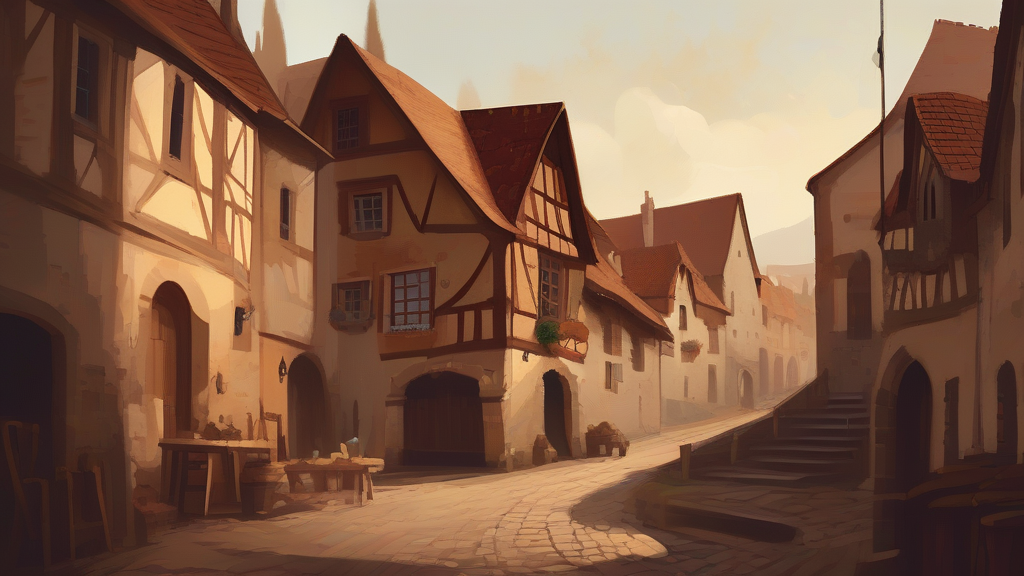
A bourg is a town — specifically, a medieval fortified settlement of modest size, most often encountered in descriptions of France and continental Europe. The word entered English by borrowing directly from French, and it belongs to a large family of related terms including "borough," "burgh," and "burgess," all ultimately descended from the same Germanic root meaning a stronghold or defended place. In modern usage, "bourg" appears chiefly in historical writing, travel literature, and place names rather than everyday conversation, lending a text a distinctly picturesque or antiquarian flavour. Writers may use it to evoke cobbled lanes, market squares, and stone rampages — the atmosphere of an old European town preserved within a larger modern city. Because it is rare and specialised, readers should treat it as a stylistic alternative to "town" best reserved for historical or descriptive contexts where its evocative quality adds value.
nounA medieval fortified town, especially one of moderate size; the term is used chiefly in historical contexts and in place names.
- A medieval fortified town of moderate size, especially in France or other parts of continental Europe.
- A historic quarter or old town section of a modern city, retaining the character of the original settlement.
"The travellers halted at dusk before the walls of a small bourg nestled in the valley."
"The market was held just outside the gates of the old bourg every Thursday."
"Tourists wandered the narrow lanes of the bourg beneath the castle ruins."
The regular plural "bourgs" follows standard English pluralisation; in some French-influenced texts the unchanged form "bourg" may appear, but "bourgs" is standard in English.
"The duchy contained several small bourgs, each ringed by its own defensive wall."
Every English "borough" and American "-burg" traces back to the same ancient word that gave us "bourg" — a little French term for a walled medieval town.
Reviewed by Deb Chak, Editor. AI-assisted content curated by RJS Tech Solutions LLP.
Etymology of bourg
"Bourg" comes from the Old French "burg" or "borc," meaning a fortified town, which itself derives from Late Latin "burgus," a borrowing from a Germanic root meaning a fortress or stronghold. The same root produced English "borough" and Scottish "burgh," as well as "burgess," "bourgeois," and "bourgeoisie." The word thus reflects the deep interweaving of Germanic and Romance languages in medieval Europe.
How bourg is actually used
"Bourg" is a literary and historical term, far more common in writing about France and medieval Europe than in everyday speech. It carries a quaint, picturesque connotation and often appears untranslated in travel writing. In ordinary contexts, "town" or "village" is preferred.
Easily confused with bourg
"Borough" is the standard English word for an administrative district or town, while "bourg" is a rare historical term for a medieval fortified town, borrowed directly from French.
"Burrow" refers to an animal's hole or dwelling and shares distant Germanic roots with "bourg," but has nothing to do with towns.