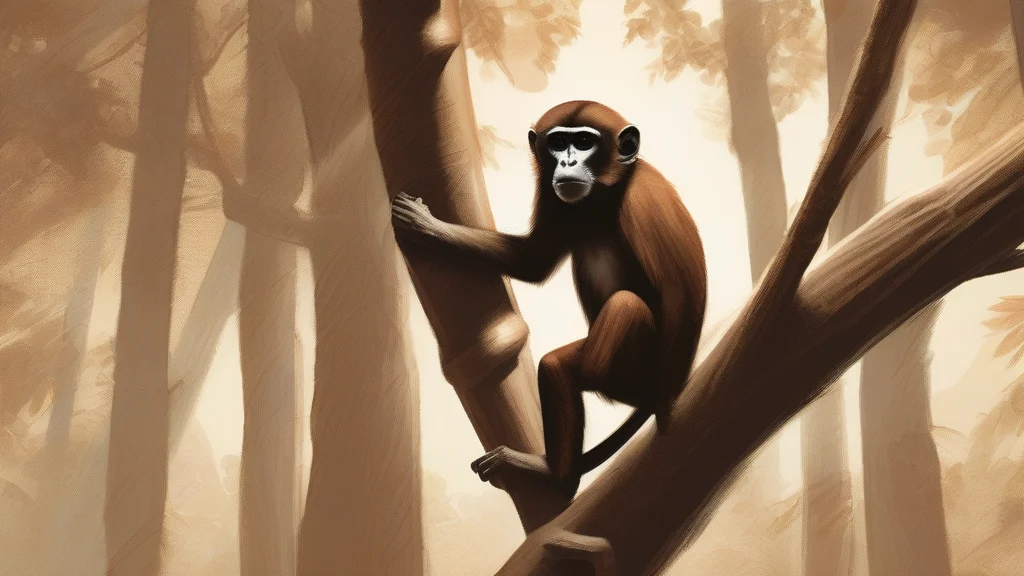
What does brachiate mean?
To brachiate is to travel by swinging from one handhold to another using the arms — the distinctive mode of locomotion seen at its most spectacular in gibbons and spider monkeys. Derived from the Latin brachium, meaning 'arm', the word belongs largely to the vocabulary of primatology, zoology, and natural-history writing rather than everyday conversation. A gibbon brachiating through the canopy can cover remarkable distances with each swing, its body suspended in a fluid, pendulum-like rhythm that walking cannot match. The related noun 'brachiation' names the movement itself, and 'brachiator' describes an animal built for it. Beyond literal use, the word occasionally appears figuratively to describe anyone moving hand over hand along bars or ropes, lending a precise, scientific flavour to what might otherwise be described simply as swinging.
verb(Of a primate) to move by swinging from hold to hold using the arms, as gibbons do through the trees. In zoology, also used adjectivally of limbs that are long and widely separated.
- (Of a primate) to progress by swinging from one handhold to another with the arms.
- (Zoology, chiefly in descriptions) having widely separated, often prehensile limbs suited to swinging locomotion.
"Gibbons brachiate effortlessly through the rainforest canopy, covering ten feet in a single swing."
"The spider monkeys brachiate across the enclosure with startling speed and precision."
"In dense forest, a gibbon may brachiate for hundreds of metres without ever touching the ground."
Gibbons don't climb through the forest — they fly between branches, and 'brachiate' is the word for it.
Reviewed by Deb Chak, Editor. AI-assisted content curated by RJS Tech Solutions LLP.
Etymology of brachiate
Brachiate comes from the Latin brachium, meaning 'arm', which also gives English 'brachial' (as in the brachial artery) and underlies 'brachiopod', literally 'arm-foot'. It entered English as a technical zoological term, first recorded around the mid-nineteenth century, when scientists sought precise vocabulary for the arm-driven locomotion of apes. Its Latin root makes it a distant cousin of 'embrace', which reached English through Old French from the same source.
Related word forms
How brachiate is actually used
A technical term used mainly in primatology, zoology, and nature writing; rare in everyday speech. The verb is typically applied to apes and monkeys rather than humans, though it can be used figuratively or playfully for human climbing.
Easily confused with brachiate
'Bifurcate' means to split into two branches, while 'brachiate' means to swing arm over arm like an ape.