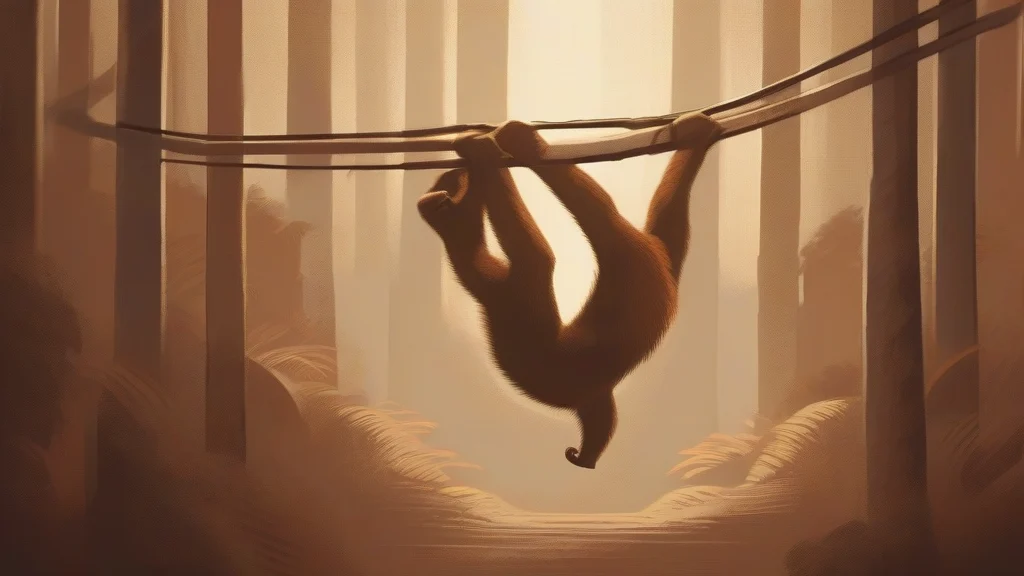
What does brachiation mean?
Brachiation is the form of locomotion in which an animal swings forward by its arms, moving hand over hand beneath branches rather than walking or climbing on top of them. The term is most closely associated with gibbons and siamangs, whose long forelimbs, mobile shoulders, and hook-like hands make them extraordinarily proficient at travelling through the forest canopy in this way — at speed, brachiation can look more like flight than climbing. The word derives from the Latin brachium, meaning 'arm', and belongs chiefly to scientific registers: it appears in primatology, physical anthropology, and comparative anatomy when researchers discuss how body structure relates to movement. Figurative use is rare, though writers sometimes borrow the word to describe athletic or playful swinging motions that recall an ape's movements. Understanding brachiation offers insight into how anatomy and habitat shape the ways animals get around.
nounThe mode of locomotion in which an animal, especially a gibbon or other ape, moves by swinging arm over arm from one handhold to another. By extension, the act of moving in this swinging manner.
- The arm-over-arm swinging locomotion characteristic of gibbons, siamangs, and some other apes.
- More broadly, any movement resembling this swinging motion.
"Gibbons move through the forest canopy with astonishing speed by brachiation."
"Watching a gibbon cross the zoo enclosure, you can see how brachiation allows it to cover ground far faster than walking could."
"Some primatologists argue that human ancestors passed through a phase of partial brachiation before becoming fully bipedal."
Rarely pluralized; the word is nearly always used as an uncountable mass noun referring to the mode of locomotion itself.
"The film captured several swift brachiations across the canopy."
A gibbon can cross a gap of ten metres using only its arms — brachiation turns the rainforest canopy into a highway.
Reviewed by Deb Chak, Editor. AI-assisted content curated by RJS Tech Solutions LLP.
Etymology of brachiation
Brachiation comes from the Latin brachium, meaning 'arm', combined with the English suffix -ation denoting an action or process. It was coined in the nineteenth century within comparative anatomy to describe the distinctive arm-powered swinging of apes, alongside the related adjective brachiate. Its cognates include brachial, relating to the arm, and brachiopod, a marine invertebrate named for its arm-like feeding structures.
Related word forms
How brachiation is actually used
Brachiation is primarily a technical term used in zoology, primatology, and physical anthropology; it rarely appears in everyday conversation. It is almost always used as an uncountable noun describing a method of movement rather than a single action.
Easily confused with brachiation
Brachiation refers to arm-over-arm swinging locomotion, while brachylogy is a rhetorical term for concise or shortened expression; they share no meaning despite a similar sound.