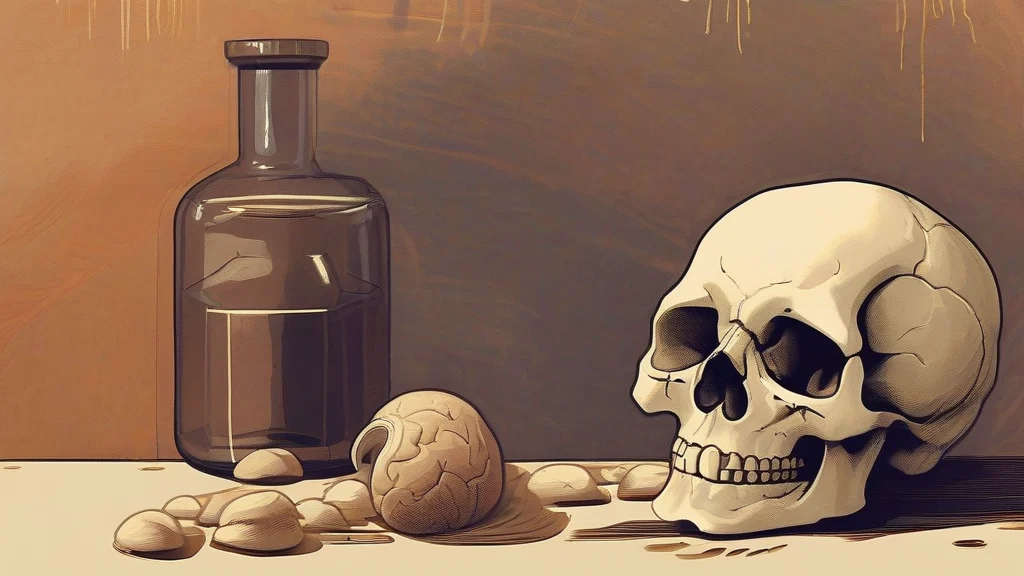
What does brainpan mean?
Brainpan is an informal, somewhat old-fashioned word for the skull — the hard bony vault that encloses and protects the brain. Formed by simply joining "brain" with "pan," it treats the head as a kind of vessel, which accounts for much of its earthy, humorous character. Though perfectly intelligible today, it belongs to a colloquial register and is rarely heard in medicine or formal writing, where "skull" and "cranium" dominate. Its chief appeal lies in its vividness and long pedigree: it appears frequently in literature from the sixteenth and seventeenth centuries, including Shakespeare, usually in violent or comic contexts such as threatening to crack someone's brainpan. Modern writers reach for it when they want a touch of archaic color, mock-heroic swagger, or plain silliness. For vocabulary lovers, brainpan is a fine example of how English compounds familiar elements into words that feel simultaneously antique and instantly understandable.
nounThe skull; the bony case enclosing the brain. Now chiefly informal, humorous, or archaic in tone.
- The skull, especially regarded as the container of the brain; often used informally, humorously, or in older/literary contexts.
"The blow glanced off his helmet rather than his unprotected brainpan."
"He rubbed the sore spot on his brainpan and laughed off the fall."
"Shakespeare's clowns and soldiers alike spoke of cracking an enemy's brainpan."
Rarely needed, since the plural arises only when referring to the skulls of multiple individuals, typically in informal or literary contexts.
"The comedy sketch had the knights banging their brainpans together for laughs."
"Brainpan" is one of those rare compound words where both halves are ancient — it's been knocking around English since before Shakespeare, and he used it himself to describe exactly where to hit an enemy.
Reviewed by Deb Chak, Editor. AI-assisted content curated by RJS Tech Solutions LLP.
Etymology of brainpan
Brainpan is a straightforward English compound of "brain" and "pan," combining two native Germanic roots rather than borrowing from Latin or French. It has been part of the language since at least the early modern period, appearing in sixteenth- and seventeenth-century texts, including Shakespeare's plays. Its cognates are not foreign borrowings but the many other English compounds built on "brain," such as brainstorm, brainy, brainchild, and brainpower, all drawing on the same Old English root for the organ of thought.
How brainpan is actually used
Register is informal, jocular, or deliberately archaic; in medical or scientific writing "skull" or "cranium" is always preferred. The word carries a slightly comic, rough-and-ready flavor and appears most often in fiction, historical dialogue, and playful speech.
Easily confused with brainpan
A brainstem is the living neural structure connecting the brain to the spinal cord, whereas a brainpan is a humorous term for the skull that houses it.