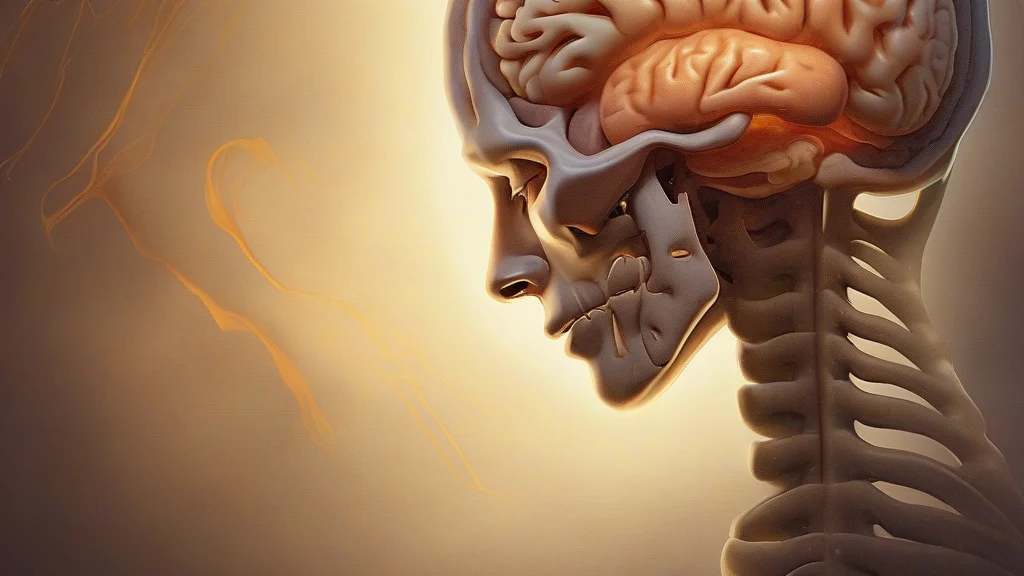
What does brainstem mean?
The brainstem is the lower, stalk-like portion of the brain that links the cerebrum and cerebellum to the spinal cord. Anatomically it consists of three parts — the midbrain, the pons, and the medulla oblongata — and it acts as the critical conduit through which all signals between the brain and body must pass. Beyond its role as a relay, the brainstem governs the body's most fundamental involuntary functions: breathing, heart rate, blood pressure, swallowing, sleep–wake cycles, and basic reflexes such as coughing and gagging. Because these processes sustain life without conscious control, the brainstem is sometimes described as the body's 'autopilot.' In medicine, brainstem function carries particular weight: its irreversible loss is central to the determination of brain death, and injuries here are often catastrophic even when higher cognitive regions remain intact. The term appears chiefly in anatomy, neurology, and scientific writing, and is typically written as one word in contemporary usage, though the two-word form 'brain stem' also occurs.
nounThe stalk-like portion of the brain that connects the cerebrum and cerebellum to the spinal cord, comprising the midbrain, pons, and medulla oblongata. It controls many automatic functions essential to life, including breathing, heart rate, and reflexes.
- (Anatomy) The posterior stalk-like part of the brain connecting the cerebrum and cerebellum to the spinal cord, consisting of the midbrain, pons, and medulla oblongata, which regulates vital involuntary functions such as respiration, heartbeat, and reflexes.
"The neurologist explained that the injury had damaged the brainstem, the region governing breathing and heart rate."
"Doctors determined that the accident had left him with severe brainstem injuries, affecting his ability to breathe unaided."
"The brainstem serves as the body's autopilot, quietly regulating breathing, swallowing, and heart rate without any conscious effort."
The plural is rare outside comparative anatomy or pathology, where multiple specimens or species are discussed.
"The researchers compared the brainstems of mammals across several species."
You could lose most of your higher brain and still technically be 'alive' — but damage to the brainstem, a structure barely three inches long, is what truly decides life and death.
Reviewed by Deb Chak, Editor. AI-assisted content curated by RJS Tech Solutions LLP.
Etymology of brainstem
The word brainstem is a straightforward English compound formed from 'brain,' of Old English origin (brægen), and 'stem,' from Old English (stefn or stemn), meaning trunk or stalk. It arose as an anatomical descriptor in the nineteenth century as neuroanatomists sought precise terminology for the brain's gross structure. Cognates of its components appear across Germanic languages, such as German 'Hirnstamm,' which pairs cognate elements for brain and stem in the same way.
How brainstem is actually used
A technical term used primarily in medical, neurological, and scientific contexts. Often written as two words ('brain stem') in some publications, though 'brainstem' is now the more common single-word form in modern medical literature.
Easily confused with brainstem
The brainstem is part of the brain itself, whereas the spinal cord is the nerve pathway running down the spine; the two are continuous but anatomically distinct structures.