
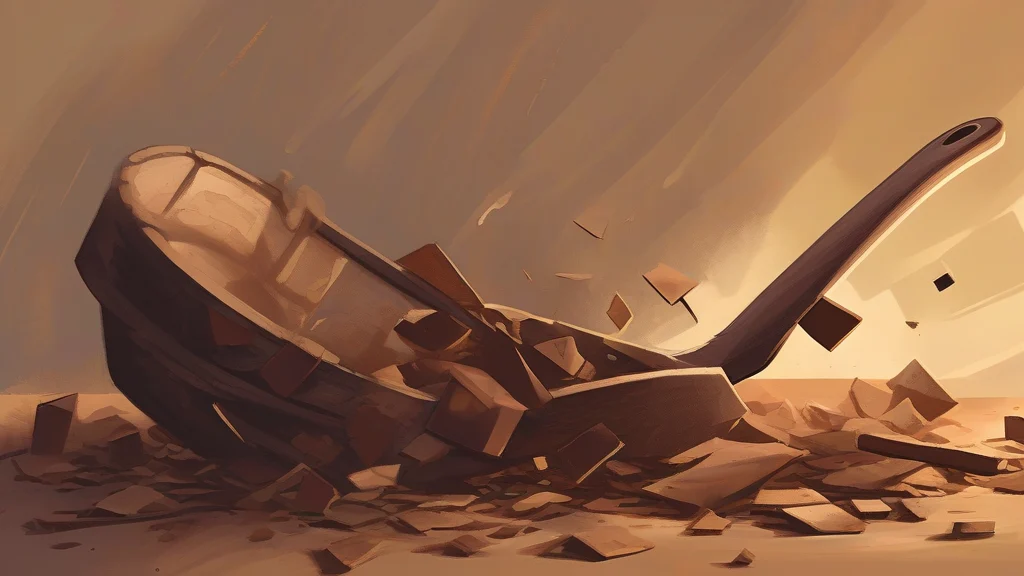
What does breakage mean?
Breakage is a noun referring to the act of breaking something, the state of being broken, or the broken pieces that result. It is most often used in practical or commercial contexts — moving companies may offer compensation for breakage, retailers track breakage losses on fragile inventory, and shipping labels warn handlers about it. The word also appears frequently in modern beauty and health writing, where "hair breakage" describes strands snapping due to heat, chemicals, or rough handling. Unlike the simple word "break," which emphasizes the action, breakage emphasizes the outcome: what got damaged and what it might cost to replace. Its tone is neutral to slightly technical rather than emotional. Derived from the verb "break" with the suffix "-age," it belongs to a family of English nouns that turn actions into measurable results, making it useful wherever damage needs to be quantified, insured, or avoided.
The act or result of breaking something, or the broken pieces produced.
"Careful packing reduced the breakage to just two plates."
Commonly paired with words about fragility or transport.
A charge or loss incurred due to damage to goods, particularly in trade or shipping.
"The invoice included a small breakage fee."
Most common in commercial and insurance contexts.
The plural is used mainly in British English and commercial contexts to refer to individual instances of damage; American English tends to use the uncountable singular form.
"We recorded several breakages during last week's deliveries."
Breakage is one of those rare words that sounds almost like its own sound effect — crisp and brittle — and it has quietly become the go-to term in haircare marketing for split ends and snapped strands.
Reviewed by Deb Chak, Editor. AI-assisted content curated by RJS Tech Solutions LLP.
Etymology of breakage
Breakage is formed from the Old English-derived verb "break" plus the suffix "-age," which came into Middle English from Old French and ultimately Latin. The suffix turns verbs into nouns denoting an action or its result, as in "package" or "wastage." The word emerged in English around the late 16th to early 17th century, primarily in commercial contexts dealing with fragile goods. Its root, "break," traces back to Proto-Germanic *brekaną, making it a native Germanic word dressed in a Romance-style suffix.
How breakage is actually used
Often used in commercial, insurance, or shipping contexts where physical damage carries a financial cost. In recent years it has also become common in haircare and cosmetics marketing. Slightly more formal than simply saying "damage."
Easily confused with breakage
"Break" is the verb (or noun) referring to the act itself, while "breakage" is the noun describing the result or cost of that breaking.
"Brokerage" refers to the business of a broker or their fee, unrelated to breaking anything despite the similar ending.