What does briar mean?
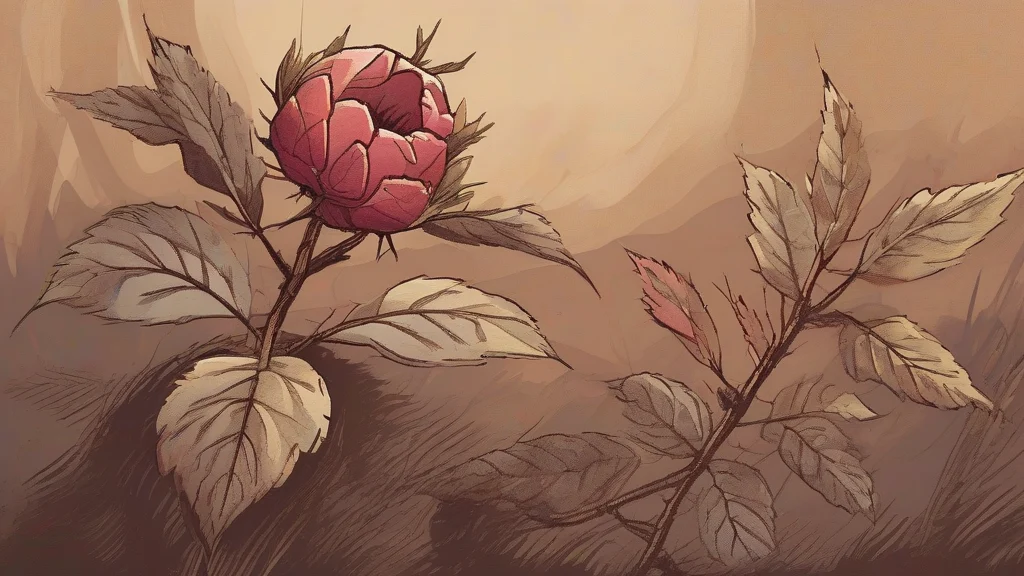
A briar is any prickly, thorny shrub that tangles across uncultivated ground — most often a wild rose, blackberry, or similar bramble. The word carries strong rustic and literary connotations, conjuring hedgerows, woodland paths, and folk tales in which characters must push through dense, scratchy growth; the "briar patch" of Br'er Rabbit fame is its best-known cultural appearance. A second, quite different sense refers to the dense, heat-resistant root of the white heath tree native to Mediterranean regions, which is carved into tobacco pipes prized for their durability and cool smoke. In this sense the word comes from the French "bruyère" (heather), reshaped under the influence of the older English "briar." Whether describing a thorny hedge or a fine pipe bowl, "briar" is a compact word with rich texture, useful both literally and figuratively for anything tangled, rough, or stubbornly entrenched.
A prickly thorny shrub or vine, especially a wild rose or blackberry bush growing in tangled thickets.
"We lost the ball in a dense patch of briars behind the fence."
Often used figuratively to suggest something entangled or troublesome.
The hard root of the white heath tree (Erica arborea), valued for making tobacco pipes.
"The artisan shaped a smooth briar into an elegant curved pipe."
Used when referring to multiple individual shrubs or patches of thorny growth.
"The hillside was covered in wild briars."
The word for a prickly wild bush got borrowed twice — once for thorns, and once, from the French "bruyère," for the prized heath roots that make the finest smoking pipes.
Reviewed by Deb Chak, Editor. AI-assisted content curated by RJS Tech Solutions LLP.
Etymology of briar
The word "briar" first appears in English in the early modern period as a variant of "brier," a Middle English term of uncertain ultimate origin referring to prickly shrubs. Its second sense has a separate route: it derives from the French "bruyère," meaning heather or heath, adopted into English in the nineteenth century when heath-root pipes became fashionable, with the spelling assimilated to the existing word "briar." This makes "briar" a rare example of two distinct etymological strands converging on one spelling.
How briar is actually used
"Briar" is a slightly literary or folksy word, evoking rural landscapes, fairy tales, and folk stories like Br'er Rabbit. The spelling "brier" is an accepted variant but less common today.
Easily confused with briar
"Brier" is simply an alternative spelling of "briar" with identical meaning, though "briar" is now the more common form.