What does blackthorn mean?
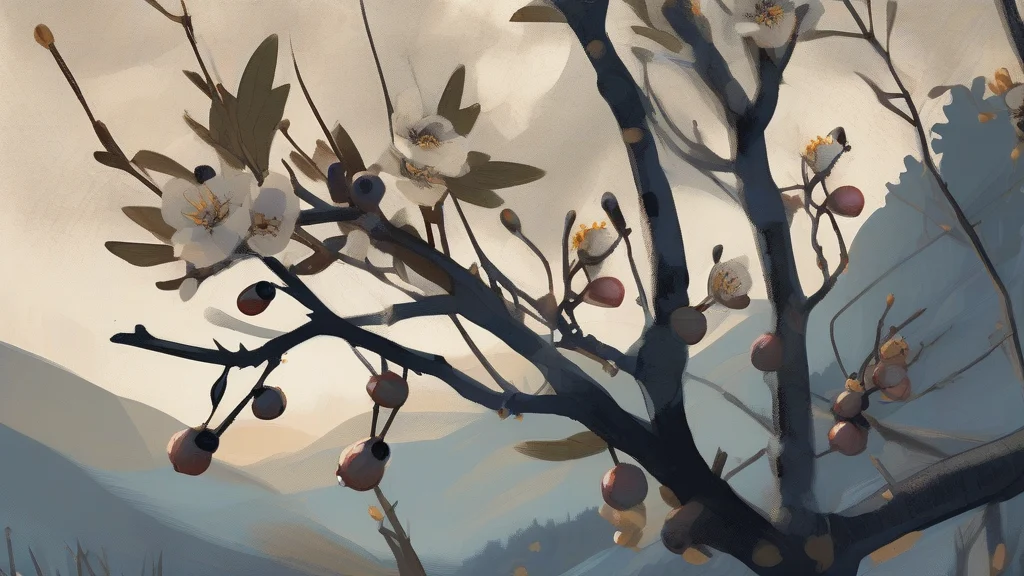
Blackthorn is a noun naming a spiny Eurasian shrub or small tree, Prunus spinosa, belonging to the plum genus within the rose family. One of the first plants to flower in the year, it covers itself in white blossom in early spring while its branches are still bare, later producing small, tart, blue-black fruits known as sloes — famously steeped in sugar and spirits to make sloe gin. The word also denotes the shrub's exceptionally hard, dense wood, prized for canes, walking sticks, and the Irish shillelagh. Blackthorn is a familiar feature of British hedgerows, where its impenetrable growth makes it a natural boundary plant, and it features prominently in folklore, where a cold spell during its flowering period is called a blackthorn winter. It should not be confused with hawthorn, which flowers later and bears different fruit.
nounA thorny Eurasian shrub or small tree (Prunus spinosa) of the rose family, bearing white blossom in early spring and small dark blue-black fruits called sloes. The term also refers to the wood of this plant.
- The spiny Eurasian shrub Prunus spinosa, which produces white spring blossom and dark purple-black sloe fruits.
- The hard, dense wood of the blackthorn, used for canes, walking sticks, and tool handles.
"The hedgerow was a tangle of blackthorn, its branches still bare but already studded with white blossom."
"Sloes gathered from the blackthorn at the field's edge were steeped in gin with sugar all through the autumn."
"He carried a sturdy blackthorn stick on his walks across the moor."
The regular plural refers to multiple individual trees or shrubs; the uncountable singular is used for the wood or for the plant as a hedging material.
"The hillside was dotted with blackthorns, each one heavy with ripe sloes."
Blackthorn blossoms in early spring before a single leaf appears — and a cold snap around that time is traditionally called a 'blackthorn winter.'
Reviewed by Deb Chak, Editor. AI-assisted content curated by RJS Tech Solutions LLP.
Etymology of blackthorn
Blackthorn is a straightforward English compound of 'black' and 'thorn,' referring to both the shrub's dark bark and its formidable spines; the compound has been in use since Old English times. The tree itself belongs to the genus Prunus, from Latin prunus meaning plum tree, which also gives us related words such as prune and, through Germanic borrowing, plum and sloe. Its species name, spinosa, is Latin for 'spiny,' a fitting description of its thicket-forming habit.
How blackthorn is actually used
Most common in British English, where blackthorn hedges are a familiar feature of the countryside; in North American usage it often appears in gardening and botany contexts. In Irish tradition the blackthorn carries strong folklore associations, including the shillelagh fighting stick. The compound 'blackthorn winter' refers to a spell of cold weather coinciding with the tree's early blossom.
Easily confused with blackthorn
Hawthorn (Crataegus) blossoms in late spring alongside its leaves, whereas blackthorn blooms earlier, on bare branches, and bears sloes rather than haws.
Blackwood refers to several dark timber trees such as Acacia melanoxylon, unrelated to the blackthorn shrub.