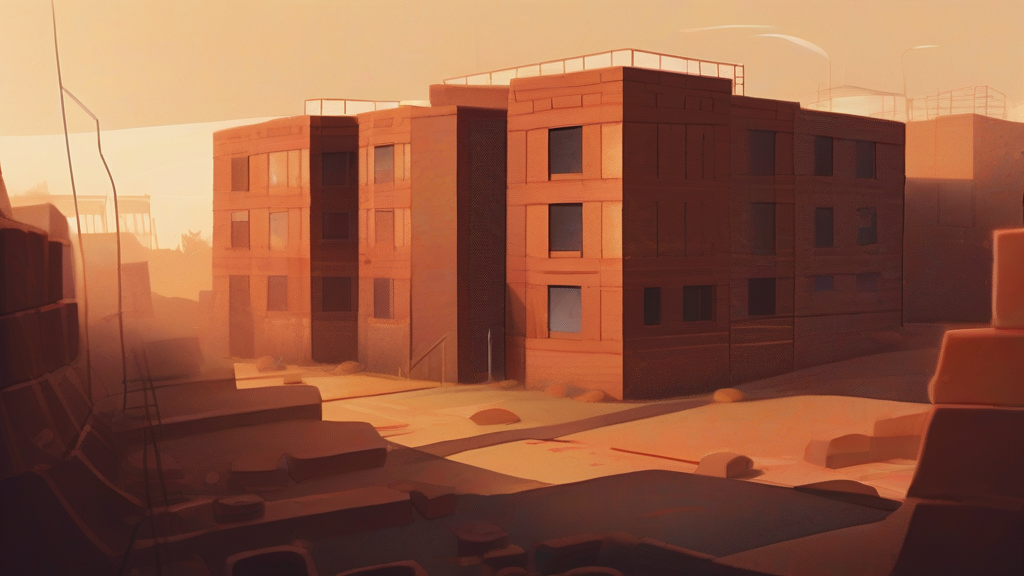
What does brickshaped mean?
"Brickshaped" is an English adjective describing something that has the form of a brick: rectangular, elongated, with flat faces and squared ends. It is a transparent compound of the noun "brick" and the suffix "-shaped," and it can be written either solid or hyphenated ("brick-shaped"), with the hyphenated form common in careful writing. The word applies literally to buildings, blocks, packages, and other rectangular solids, but it is often used figuratively and sometimes humorously for bulky, unrefined objects — early mobile phones are famously described as brickshaped, as are dense loaves of bread or heavy old electronics. The term carries no strong positive or negative connotation on its own; any judgment comes from context, so a brickshaped loaf may be praised for its heft while a brickshaped phone is mocked for its size. It is a useful, precise word whenever plain terms like "rectangular" feel too geometric and impersonal.
adjectiveHaving the shape of a brick; rectangular and oblong with roughly squared ends, typically longer than it is wide.
- Having the rectangular, elongated form of a standard building brick.
"The bakery sold dense, brickshaped loaves of rye bread."
"The old television set was a heavy, brickshaped object that dominated the living room."
"She packed the brickshaped cartons neatly into the back of the van."
From phones to houses to loaves of bread, "brickshaped" is the go-to word for anything that looks like it came off a mason's pallet — even though bricks themselves vary in size around the world.
Reviewed by Deb Chak, Editor. AI-assisted content curated by RJS Tech Solutions LLP.
Etymology of brickshaped
"Brickshaped" combines "brick," which entered Middle English from Middle Dutch or Middle Low German "bricke" (a building block), with "-shaped," from the Old English-derived verb "shape." As a productive compound, it arose naturally in modern English rather than being borrowed, and comparable formations such as "egg-shaped" and "wedge-shaped" follow the same pattern. It has no distant cognates beyond those shared with "brick" itself and its Germanic relatives in Dutch and German.
How brickshaped is actually used
Informal to neutral register. Often written as two words ("brick-shaped"), though the closed form appears in print. Frequently used figuratively to describe bulky, blocky objects such as early mobile phones or dense baked goods.
Easily confused with brickshaped
"Brick-shaped" describes the physical form of a brick, while "brick-like" more broadly means resembling a brick in any quality, including heaviness, hardness, or sturdiness.