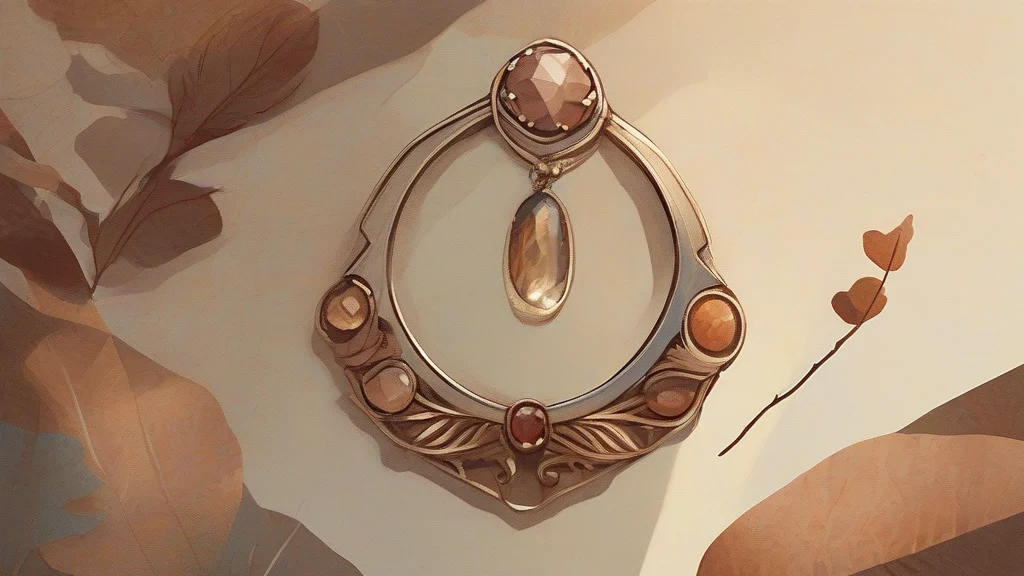
What does brooched mean?
Brooched is the past tense and past participle of the verb to brooch, meaning fastened or ornamented with a brooch — a decorative pin, typically of metal, worn on clothing or used to secure a garment such as a cloak, scarf, or sash. A sentence like 'her cape was brooched at the shoulder' describes both a practical act of fastening and an act of adornment, since brooches are jewellery as much as they are clasps. The word derives from Old French broche, originally meaning a skewer or spit, from a Latin root meaning pointed; the same root gives us the unrelated-sounding verb 'to broach'. In modern English, 'brooched' is uncommon — people more often say something is 'pinned' or 'held by a brooch' — but it survives in fashion writing, historical description, and costume terminology. It is also frequently confused with 'broached', which concerns raising topics or opening barrels rather than jewellery.
verb (past tense and past participle of 'brooch')Fastened or adorned with a brooch, an ornamental pin with a clasp. As a verb, to have pinned or secured a garment or fabric using such a piece of jewellery.
- Fastened or decorated with a brooch (ornamental pin).
"She brooched her silk scarf at the collar before stepping out into the cold."
"Her velvet cape was brooched with an antique silver cameo."
"He brooched the folds of his kilt's plaid in the traditional Highland manner."
A brooch was originally a sharpened skewer for roasting meat — the Latin root 'broccus' meant 'pointed' — so when you say a shawl was 'brooched', you're echoing an ancient cooking implement turned jewel.
Reviewed by Deb Chak, Editor. AI-assisted content curated by RJS Tech Solutions LLP.
Etymology of brooched
The word traces back through Middle English to Old French broche, meaning a pointed tool, skewer, or spit, ultimately from Latin broccus ('projecting, pointed'). The noun 'brooch' entered English in the medieval period for a pin or clasp, retaining the sense of a pointed fastener. The verbal form 'brooched', meaning fastened with such a pin, developed naturally from the noun. Its cousin 'broach', from the same Old French source, took a different semantic path toward raising subjects and piercing casks.
Related word forms
How brooched is actually used
'Brooched' is rare in everyday usage; most writers prefer constructions like 'wearing a brooch' or 'a scarf pinned with a brooch'. The verb form is chiefly found in descriptive or historical writing about dress. It should not be confused with the far more common homophone-adjacent word 'broached'.
Easily confused with brooched
'Broached' is the past tense of the verb 'to broach' (to raise a subject or open a cask), while 'brooched' relates only to the ornamental pin called a brooch — the two are pronounced differently (/brəʊtʃt/ vs /brəʊtʃd/) despite their similar spelling.