What does brook mean?
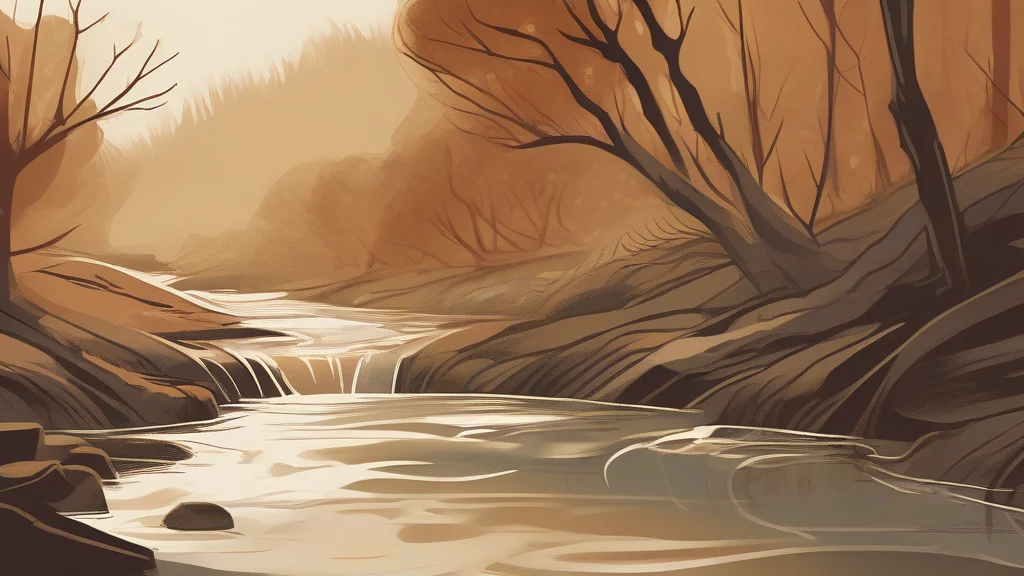
A brook is a small, natural stream of fresh water, smaller than a creek or river and typically feeding into a larger watercourse. The word evokes pastoral imagery — babbling brooks, wooded valleys, clear cold water — which has made it a favorite in poetry, landscape description, and place names throughout the English-speaking world. Regional alternatives include 'beck' in northern England and 'burn' in Scotland, while American English more often uses 'creek.' Separately, 'brook' functions as a formal verb meaning to tolerate or endure something, though only in negative constructions: one might say a ruler 'will brook no opposition,' never that he 'brooks' it happily. This verb sense descends from an Old English word meaning to make use of or enjoy something, a meaning that gradually narrowed to its modern, mostly figurative role. Together, the two senses make 'brook' a compact example of how a single spelling can carry both a concrete landscape term and a literary idiom centuries old.
A small natural stream of fresh water flowing into a river or other larger body of water.
"Children spent the summer afternoon splashing in the cool shallows of the brook."
Often modified by evocative adjectives such as 'babbling,' 'murmuring,' or 'shallow' in literary prose.
To tolerate, bear, or permit something; used almost exclusively in negative constructions.
"She brooked no interruption during the board meeting."
Nearly always appears as 'brook no...' or in the pattern 'will/would not brook'; affirmative use sounds archaic.
Regular plural; commonly used in plural when describing landscapes dotted with many small streams.
"The highlands are laced with brooks that feed the larger rivers below."
The verb 'to brook' — meaning 'to tolerate' — is over a thousand years old and once meant simply 'to enjoy'; it survives today almost exclusively in phrases like 'will brook no interference.'
Reviewed by Deb Chak, Editor. AI-assisted content curated by RJS Tech Solutions LLP.
Etymology of brook
The noun 'brook' comes from Old English 'brōc,' meaning a stream, and is of Germanic origin. The verb 'brook' derives from a distinct Old English word, 'brūcan,' meaning 'to use, enjoy, or profit from,' which shares a Proto-Indo-European root (*bʰruHg-, 'to enjoy') with Latin 'fruī,' source of 'fruit,' 'frugal,' and 'enjoy.' Over the Middle English period the verb's sense shifted from enjoyment to tolerance, leaving behind the modern construction 'to brook no X.' The diminutive form 'brooklet' preserves the noun in current use.
Related word forms
How brook is actually used
As a noun, 'brook' carries a gentle, pastoral connotation and appears often in literary and descriptive writing; regional synonyms include 'beck' (northern England) and 'burn' (Scotland). The verb sense is distinctly formal or literary and is nearly always negated ('will not brook', 'brooks no argument'); using it affirmatively would sound archaic.