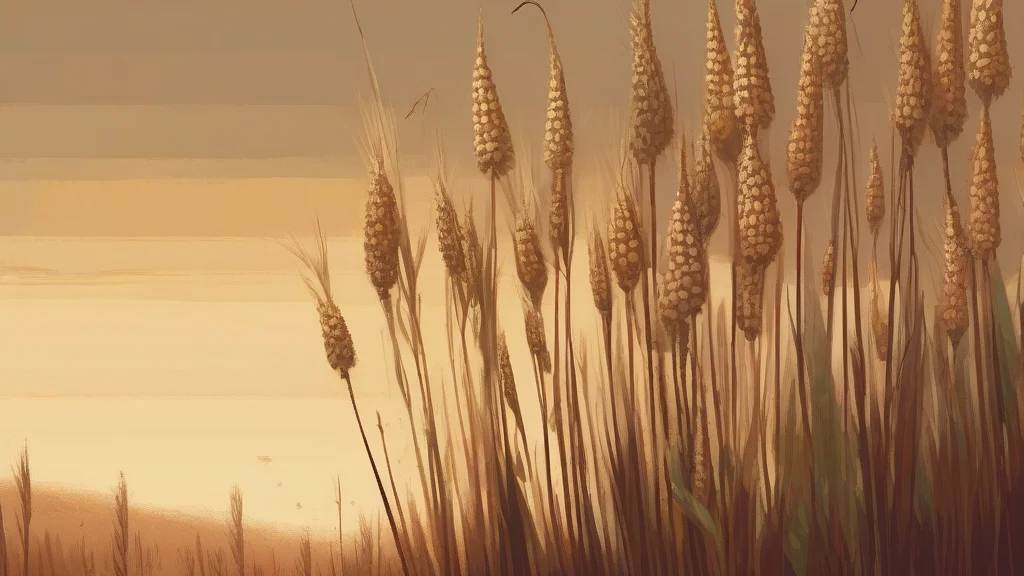
What does broomcorn mean?
Broomcorn is a tall, cane-like variety of sorghum (Sorghum bicolor) cultivated not for its grain but for its long, stiff, fibrous seed heads, which are harvested, dried, and bound into the bristles of brooms and brushes. Despite its name, it is neither true corn nor related to the broom plant; the name simply reflects its two chief associations — its corn-like growth habit and its use in broom-making. The crop was historically important in North America, where regions such as Oklahoma and Illinois became major producers in the nineteenth century, supplying material for a flourishing domestic broom industry. Today broomcorn survives chiefly as a specialist agricultural term, encountered in discussions of traditional crafts, heirloom crops, and handcrafted brooms. It appears most naturally in phrases like 'broomcorn broom' or 'broomcorn tassel,' and remains a word worth knowing for anyone interested in the plants behind everyday objects.
nounA variety of sorghum (Sorghum bicolor) with a stiff, fibrous seed head, cultivated for making the bristles of brooms and brushes.
- A variety of sorghum with stiff, fibrous panicles grown for making broom and brush bristles.
"The farmer harvested the broomcorn by hand, bundling the tassels for the brushmaker."
"The workshop smelled of freshly dried broomcorn waiting to be stitched into brooms."
"In the late 1800s, Illinois farms devoted thousands of acres to broomcorn for the nation's brushmakers."
Usually treated as uncountable when referring to the crop collectively; the plural 'broomcorns' appears mainly when counting individual plants or varieties.
"Two varieties of broomcorns were planted side by side to compare fiber quality."
Every old-fashioned kitchen broom got its bristles from a tall grass called broomcorn — a crop so essential that 19th-century America turned it into an entire industry.
Reviewed by Deb Chak, Editor. AI-assisted content curated by RJS Tech Solutions LLP.
Etymology of broomcorn
Broomcorn is an English compound of 'broom' (from Old English brōm, meaning the shrub used for sweeping) and 'corn' (from Old English corn, meaning grain or seed). The compound arose because the plant's grain-bearing panicle resembled that of cereal grains while serving the function once performed by broom twigs. The term became established in English by the eighteenth and nineteenth centuries, particularly in American agricultural usage as cultivation of sorghum for broom-making spread.
How broomcorn is actually used
An agricultural and trade term rather than everyday vocabulary; it is uncountable when referring to the crop in general and countable when referring to individual plants or stalks.
Easily confused with broomcorn
A broomstick is only the wooden handle of a broom, whereas broomcorn is the plant whose fibers form the sweeping bristles.
Corn refers to cereal grain such as maize or wheat, while broomcorn is a sorghum grown not for grain but for its fibrous seed heads used in bristles.