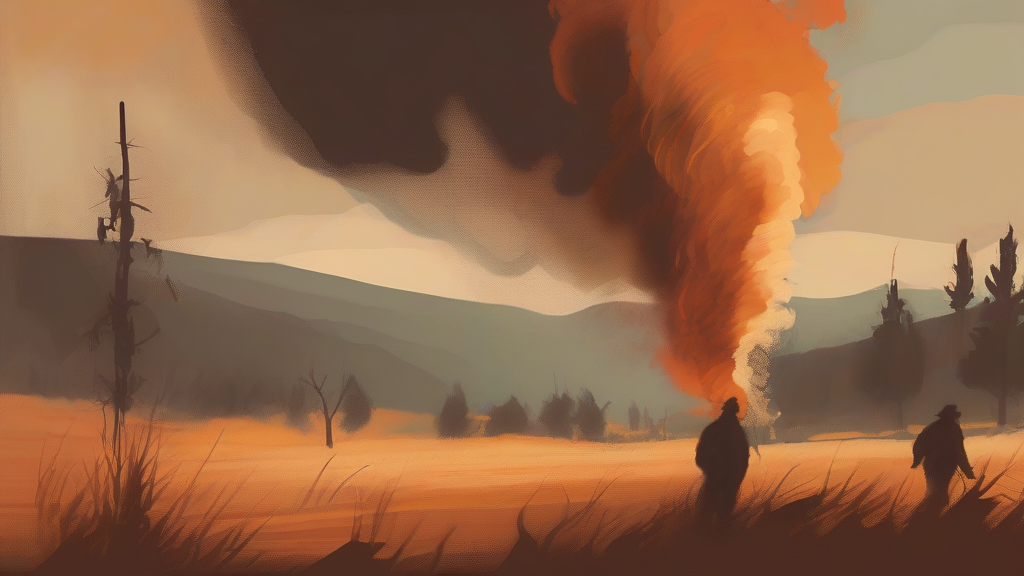
What does brushfire mean?
A brushfire is a fire that burns through brush, scrub, and other low-lying dry vegetation. Smaller and more localized than a full-scale wildfire, it can nonetheless spread rapidly across parched ground, especially in hot, windy conditions, and is a familiar subject of news reports and firefighting efforts in regions prone to dry seasons. Beyond its literal meaning, brushfire has developed an established figurative use, describing minor conflicts or disputes that flare up suddenly and resist easy resolution — most often in the fixed expressions 'brushfire war' and 'brushfire fighting.' In this extended sense, the word evokes something persistent and irritating rather than catastrophic, a smoldering problem that demands constant attention. The term is standard in both British and American English, though Australians favor 'bushfire' for the literal phenomenon. Its vivid imagery makes it a useful word for anyone writing about either natural events or simmering conflicts.
nounA small fire in brush, scrub, or dry vegetation that spreads quickly but is typically less intense and more localized than a major wildfire; figuratively, a minor but spreading conflict, dispute, or outbreak of unrest.
- A fire burning in brush or scrub vegetation, typically small to moderate in size and localized.
- Figuratively: a minor conflict, controversy, or outbreak of unrest that flares up quickly, often used attributively (e.g., brushfire war, brushfire dispute).
"Firefighters contained the brushfire before it reached the hillside homes."
"A stray spark from the campfire started a brushfire that raced through the dry chaparral."
"The government found itself putting out diplomatic brushfires on several fronts at once."
The plural is regular and commonly used, especially in news reporting when referring to multiple simultaneous fires or figurative conflicts.
"Dry winds fueled several brushfires across the county overnight."
In military slang, a 'brushfire war' describes one of those small, smoldering conflicts that keeps flaring up far from the headlines — proof that the word burns as well politically as it does literally.
Reviewed by Deb Chak, Editor. AI-assisted content curated by RJS Tech Solutions LLP.
Etymology of brushfire
Brushfire is a compound of two native English words: 'brush,' referring to dense shrubs and undergrowth (a word of uncertain origin, possibly from Old French 'brosse'), and 'fire,' from Old English 'fȳr.' The compound arose naturally in English-speaking settler communities where fires in scrubland were a recurring hazard, with usage attested from at least the nineteenth century. It shares its first element with related compounds such as brushwood and brushland.
How brushfire is actually used
The literal sense is common in firefighting, news reporting, and everyday speech in both British and American English. In Australian English, the closely related term 'bushfire' is preferred. The figurative sense is almost always attributive — appearing before nouns such as 'war,' 'fighting,' 'dispute,' or 'controversy' — and carries a connotation of something small-scale but persistent and hard to extinguish.
Easily confused with brushfire
A wildfire is any large uncontrolled fire in wildland areas, while a brushfire specifically burns low scrub vegetation and is usually smaller and less intense.