What does brushwood mean?
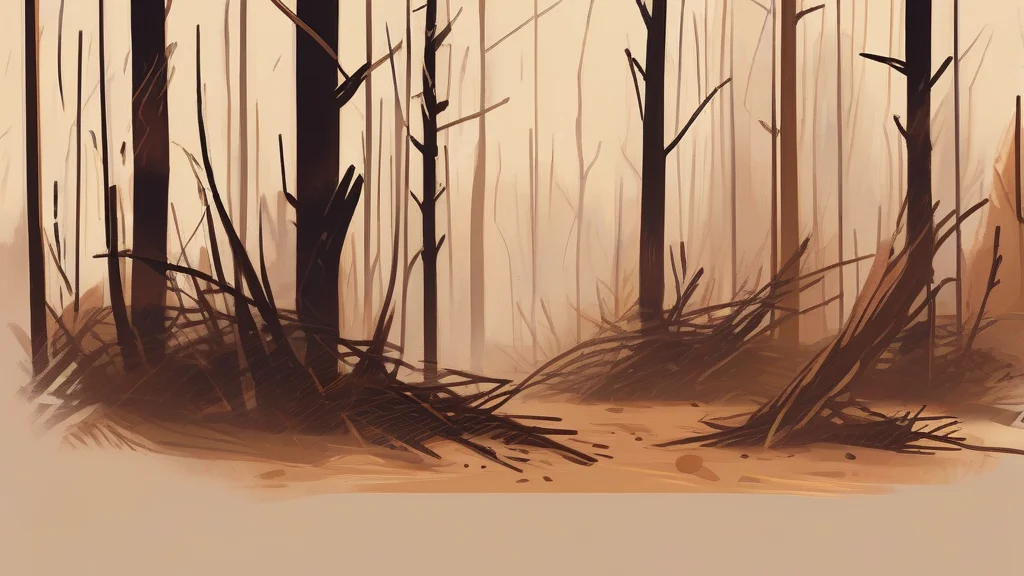
Brushwood refers collectively to the small branches, twigs, and woody debris cut or broken from trees and shrubs, particularly when gathered for use as fuel. It can also describe the dense, low-lying growth of shrubs and saplings that carpets woodland floors or covers neglected land. The word has deep practical roots: for centuries, brushwood was essential kindling, the first layer of any fire before larger logs could catch. Today it appears frequently in discussions of forest management, where clearing brushwood reduces wildfire risk, and in rural or historical writing that evokes traditional ways of life. Its connotations are earthy and pastoral rather than technical, lending prose a rustic texture. Though 'brush' is more common in everyday American speech, 'brushwood' remains precise and evocative whenever the emphasis falls on the material itself — the tangled armfuls of twiggy wood waiting to be burned.
nounBrushwood is a mass of small cut or broken branches, twigs, and undergrowth, especially as gathered for fuel or cleared from land.
- Small branches, twigs, and broken wood cut or gathered from trees and shrubs, used chiefly as fuel or kindling.
- Dense low-growing vegetation consisting of shrubs, small trees, and undergrowth covering an area of land.
"The villagers collected brushwood from the forest floor to kindle their fires."
"She stacked the dry brushwood neatly beside the hearth before dusk fell."
"The path disappeared beneath a tangle of brushwood that had grown unchecked for years."
Rarely used; brushwood is normally uncountable. A plural form occasionally appears when referring to multiple distinct areas or piles of such growth.
"The surveyors marked several brushwoods along the boundary of the estate."
Before matches were cheap and coal was king, a household's warmth began with someone walking out to gather brushwood — the humble twigs that turned a spark into a fire.
Reviewed by Deb Chak, Editor. AI-assisted content curated by RJS Tech Solutions LLP.
Etymology of brushwood
Brushwood is a compound of 'brush', meaning cut branches or undergrowth, and 'wood'. The element 'brush' in this sense came into Middle English, likely borrowed from Old French 'broce' or 'broche', meaning thicket or undergrowth, which itself traces back through Vulgar Latin to Latin forms related to 'brucus' (heath or brushland). The compound brushwood is attested by the early modern period and has long denoted both gathered firewood and thick low vegetation.
How brushwood is actually used
The word carries a rustic, somewhat old-fashioned register in modern English; it appears most often in descriptions of rural life, historical fiction, forestry management, and traditional cooking. In North American usage, 'brush' alone is more common for dense vegetation, while 'brushwood' remains standard in British English and in contexts involving firewood gathering.
Easily confused with brushwood
Brush is the broader term covering both an implement with bristles and dense vegetation generally, whereas brushwood refers specifically to small branches and twigs as material.