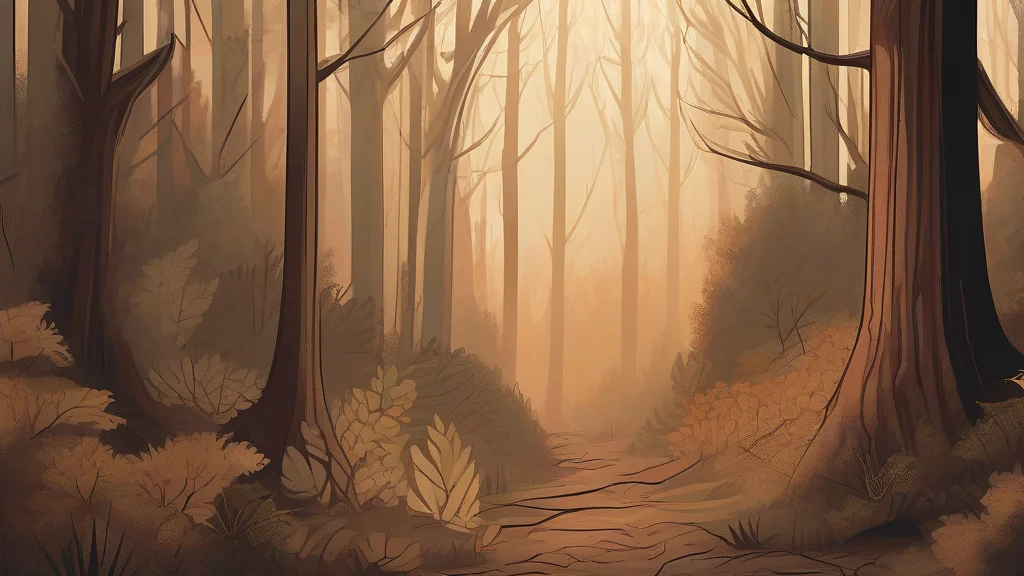
What does boscage mean?
Boscage is a literary noun referring to a dense growth of trees, shrubs, and undergrowth — essentially, thick woodland vegetation regarded as a whole. The word appears most often in poetry, prose describing rural scenes, and art historical writing about paintings, where it can also denote painted foliage serving as a background. Its tone is elevated and picturesque: writers choose boscage over ordinary terms like thicket or brushwood precisely because it lends a scene an air of classical refinement, evoking the wooded backdrops of Renaissance landscapes. In use, it typically appears in phrases describing animals vanishing into cover, figures emerging from greenery, or ornamental planting arranged to form a screen. Though rare in everyday conversation, boscage remains valuable for anyone writing descriptively about gardens, hunting scenes, or pastoral landscapes, offering precision and elegance where more common words would sound plain.
nounA mass of trees and shrubs; thick, dense woodland growth or undergrowth forming a screen or backdrop.
- A mass of trees and shrubs; dense woodland or undergrowth, especially as forming a screen or background.
- (In painting and landscape design) foliage or wooded scenery depicted as a background.
"The deer slipped silently into the boscage at the edge of the meadow."
"Rabbits darted into the boscage before the hounds could reach them."
"The tapestry showed nobles hunting amid rich green boscage."
The plural is rare, appearing mainly in descriptive or technical writing to refer to multiple areas of dense growth.
"The estate's formal gardens were broken by wild boscages of native oak and hazel."
Boscage is the painterly word for the leafy backdrop that Renaissance artists used to frame their subjects — a term borrowed straight from the woods.
Reviewed by Deb Chak, Editor. AI-assisted content curated by RJS Tech Solutions LLP.
Etymology of boscage
Boscage entered English from Old French bosage, derived from bois meaning 'wood', which traces back through medieval Latin boscus to the Germanic root behind modern English 'bush'. It was adopted into English in the late Middle Ages, when French vocabulary for woodland and hunting supplied many such terms. Its cognates include the adjective 'bosky', meaning woody or covered with trees, drawn from the same source.
How boscage is actually used
Boscage is a literary and somewhat archaic word, now found mainly in poetry, art history, and descriptions of classical landscapes. It carries a cultivated, picturesque connotation rather than an everyday one.
Easily confused with boscage
Bask means to lie in warmth (as in sunlight), while boscage is a noun denoting dense growth of trees and shrubs.