What does buckler mean?
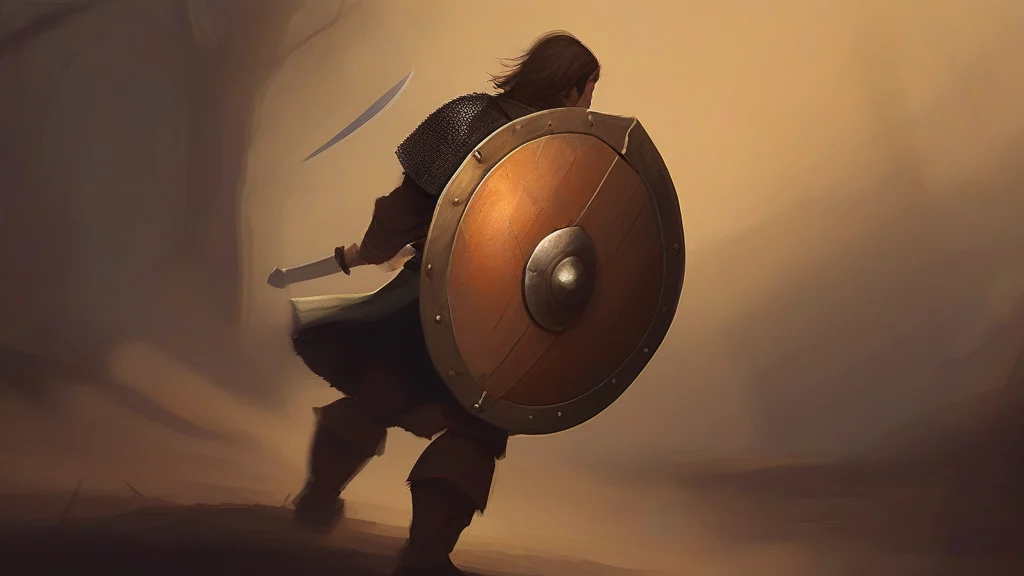
A buckler is a small, typically round shield, usually about the size of a dinner plate, held by a central handle on the back or strapped to the forearm. Unlike larger shields such as the kite or heater shield, the buckler was designed for agility: it was light enough to be maneuvered quickly to parry blows, catch an opponent's blade, or punch in close-quarters fighting, making it a favored companion to the sword among medieval infantrymen and Renaissance duelists. The phrase 'sword and buckler' became so entrenched that it described an entire style of fencing practiced across Europe for centuries. By extension, writers have used 'buckler' figuratively to mean any source of protection or defense, echoing its appearance in older religious and literary texts. Today the word survives mainly in historical, martial-arts, and literary contexts, lending any sentence a distinctly archaic, armored flavor.
A small round shield held by a grip or worn on the arm, used especially in the Middle Ages for parrying in close combat.
"The duelist deflected the thrust with his buckler and riposted."
Chiefly historical; often appears in the set phrase 'sword and buckler'.
Figuratively, anything that protects or defends; a safeguard.
"She took up her integrity as a buckler against slander."
Regular plural; used when referring to multiple shields or figurative protections.
"The museum's armory displays dozens of medieval bucklers behind glass."
Shakespeare's 'sword-and-buckler men' were the street brawlers of Elizabethan England — and the buckler was their signature weapon.
Reviewed by Deb Chak, Editor. AI-assisted content curated by RJS Tech Solutions LLP.
Etymology of buckler
'Buckler' entered Middle English around the thirteenth century from Old French 'bocler' or 'boucler', meaning a shield with a boss or protuberance. The French term derives from 'bocle', the boss at a shield's center, which traces back to Latin 'buccula', a diminutive of 'bucca', meaning 'cheek'. The same Latin root gave English 'buckle' and 'bouclé', all sharing the sense of something rounded or swelling outward like a cheek.
Related word forms
How buckler is actually used
In modern English 'buckler' is almost entirely historical or figurative, appearing in discussions of medieval warfare, heraldry, and literature. It carries an archaic, chivalric connotation rather than everyday use.
Easily confused with buckler
Knuckle refers to a joint of the finger, while a buckler is a small round shield — they merely share a similar sound.
A buckle is a fastening clasp, whereas a buckler is a small shield; both derive ultimately from the same Latin root but mean entirely different things.