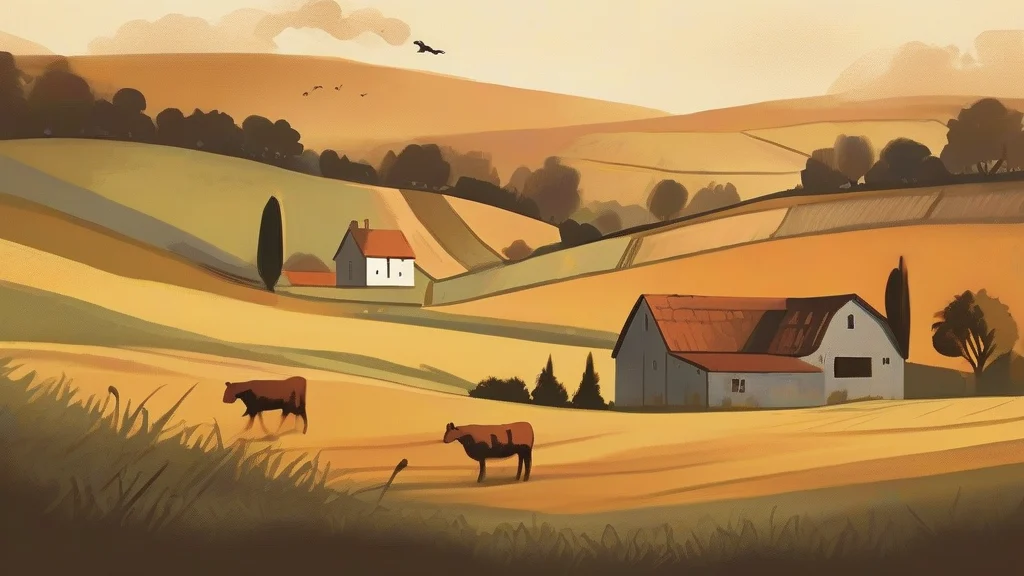
What does bucolic mean?
Bucolic is an adjective used to describe the charming, idealized qualities of countryside and rural life — think rolling pastures, grazing livestock, and unhurried village routines. It carries strongly positive connotations of peace, simplicity, and natural beauty, often appearing in phrases like 'bucolic setting' or 'bucolic charm'. The word derives from the Greek boukolikos, meaning 'of a cowherd', which also gives us the noun sense: the Bucolics are a famous set of pastoral poems by the Roman poet Virgil celebrating shepherd life. In modern usage, bucolic frequently appears in travel writing and real estate descriptions, evoking an escape from urban bustle. It can occasionally carry a hint of irony, implying a somewhat sentimental or naive picture of rural existence. Related words include pastoral, rustic, and arcadian, all of which share this romantic view of the countryside, though each has its own distinct shade of meaning.
Of or relating to the pleasant, idyllic aspects of countryside life; rustic and charmingly rural.
"The painting captures a bucolic scene of farmers harvesting wheat at sunset."
A pastoral poem, especially one depicting shepherds and rural life; usually encountered in the plural as 'the Bucolics'.
"Virgil's Bucolics drew inspiration from Theocritus's earlier Greek idylls."
As a noun, typically pluralized when referring collectively to pastoral poems; singular use is rare.
"The anthology includes several bucolics alongside other classical verse."
Bucolic comes from the Greek for 'cowherd' — so calling a scene bucolic is literally calling it fit for cattle-herding poets.
Reviewed by Deb Chak, Editor. AI-assisted content curated by RJS Tech Solutions LLP.
Etymology of bucolic
Bucolic traces back to the Greek boukolikos, from boukolos ('cowherd'), itself derived from bous ('ox' or 'cow'). The term entered English in the early 17th century via Latin bucolicus, initially referring to pastoral poetry before broadening into its modern adjectival sense describing rural scenery and life. Its Greek root bous is distantly related to words like 'buffoon' (via Italian bufala, from Latin bubalus) and 'boulevard' (from Dutch bolwerk, influenced by Germanic forms of the same root).
Related word forms
How bucolic is actually used
Generally positive or romantic in connotation, sometimes slightly literary or elevated in register. Occasionally used with mild irony to suggest an idealized or naive view of country life.
Easily confused with bucolic
'Bucolic' relates to rural or pastoral life, while 'bubonic' refers to bubonic plague, an infectious disease.