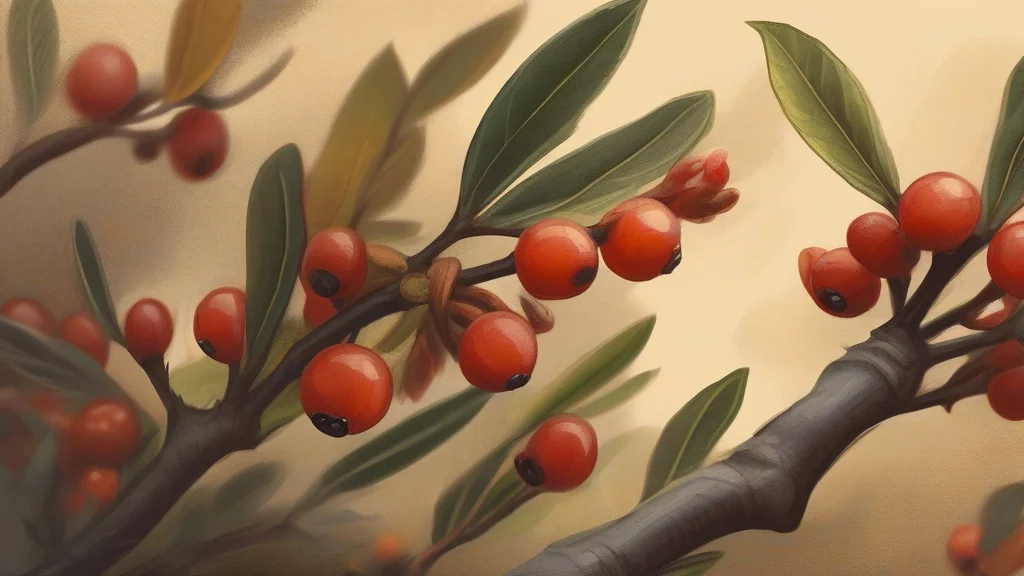
What does buffaloberry mean?
The buffaloberry is a hardy, thorny shrub of the genus Shepherdia, native to the northern and western regions of North America, especially the Great Plains. It is best known for its clusters of small, scarlet or yellow-orange berries, which are edible though notably tart and bitter when eaten fresh. The name derives from the plant's abundance on lands where bison grazed, and the berries hold an important place in Indigenous foodways: Plains peoples long gathered them to flavor pemmican, the durable mixture of dried meat and fat that sustained travelers and hunters. Today the buffaloberry appears mainly in botanical writing, foraging guides, and artisanal products such as jams and sauces. Beyond its culinary use, the shrub is valued as an ornamental windbreak and for erosion control, prized for its silvery foliage and tolerance of drought and poor soils.
nounA North American shrub of the genus Shepherdia, especially Shepherdia argentea, bearing small red or yellow-orange edible berries; also the berry itself.
- A thorny North American shrub of the genus Shepherdia, especially Shepherdia argentea, common on the Great Plains.
- The small red or yellow-orange edible berry of this shrub, tart and slightly bitter when raw.
"The plains tribes harvested buffaloberries each autumn to mix into pemmican."
"The silver-green leaves of the buffaloberry made it a popular choice for windbreak plantings across the prairie states."
"She simmered the tart buffaloberries with sugar until they yielded a deep ruby jam."
The regular plural applies to both the shrubs and their berries; 'buffaloberry' as a mass noun can refer to the fruit generally, e.g. in jam.
"The birds stripped every last buffaloberry from the hedge before the first frost."
Buffaloberries got their name because they grew wherever bison roamed — and Native Americans pounded them into pemmican long before European settlers ever tasted one.
Reviewed by Deb Chak, Editor. AI-assisted content curated by RJS Tech Solutions LLP.
Etymology of buffaloberry
The word 'buffaloberry' combines 'buffalo' — from Portuguese bufalo, ultimately from Latin bubalus, meaning wild ox — with 'berry', from Old English berie. The compound arose in nineteenth-century North America, named for the shrub's prevalence on the ranges of the American bison, then commonly called buffalo. Its closest relatives are other compounds built on 'berry' and words descended from Latin bubalus.
Related word forms
How buffaloberry is actually used
The word is chiefly North American, used most often in botanical, foraging, and regional food contexts. The berries are rarely sold commercially but are well known among foragers and in Native American culinary traditions. Both 'buffaloberry' and 'buffalo berry' appear in print, with the closed form increasingly standard.
Easily confused with buffaloberry
Wolfberry (goji berry) is a shrub of the genus Lycium native to Asia, whereas buffaloberry belongs to the North American genus Shepherdia.
A buffalo is a large bovine mammal, while a buffaloberry is the small fruit of a thorny North American shrub named for its association with buffalo range.