
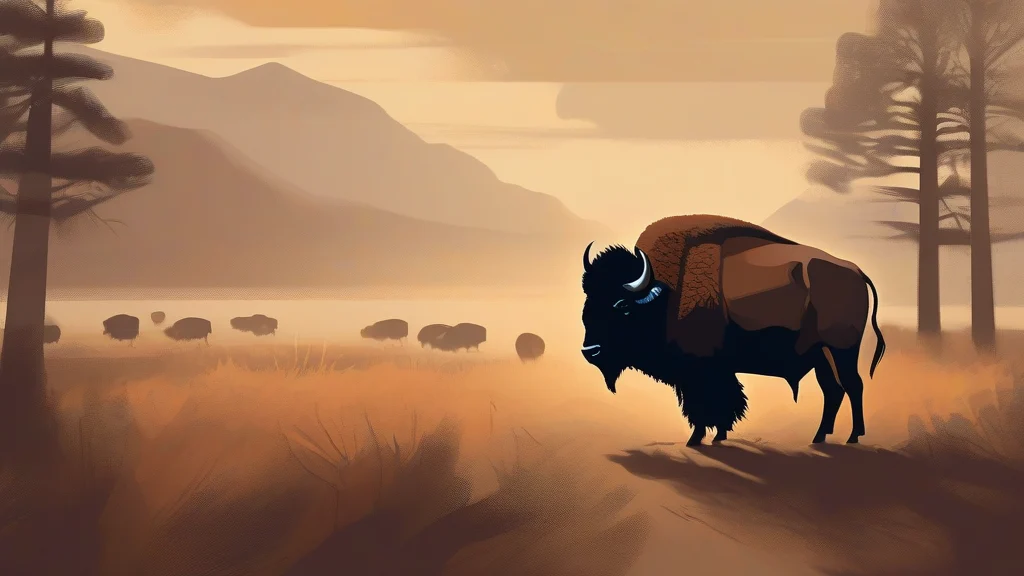
What does buffalo mean?
Buffalo is a noun denoting large, heavily built members of the cattle family, most precisely the African Cape buffalo and the Asian water buffalo, both formidable horned oxen. In everyday North American usage, however, 'buffalo' is also the traditional name for the American bison, the great shaggy herbivore of the plains, even though scientists classify it separately. The word carries connotations of raw strength, endurance, and untamed wilderness, and it appears in familiar contexts ranging from wildlife documentaries and sports team names to food (as in 'buffalo wings' and buffalo mozzarella, made from water-buffalo milk). As a verb, chiefly in informal American English, 'to buffalo' means to intimidate or confuse. Its plural forms vary — buffaloes, buffalos, or unchanged buffalo — making it a small curiosity of English grammar. Few common words carry such weight of history, ecology, and cultural symbolism.
A large wild ox of the cattle tribe Bovini, specifically the African buffalo (Syncerus caffer) or the Asian water buffalo (Bubalus bubalis); also, informally, the American bison (Bison bison).
"Cape buffalo are among the most dangerous animals to encounter on foot in Africa."
Plural forms: buffaloes, buffalos, or unchanged buffalo; the unchanged form often appears after numbers or when referring to collective herds or meat.
To intimidate, overawe, or bewilder someone.
"He refused to be buffaloed into signing the contract."
Informal and chiefly used in North America.
All three plurals are accepted; the unchanged form is common after numerals or in reference to herds and to buffalo as meat.
"We saw dozens of buffalo crossing the river at dawn."
'Buffalo buffalo Buffalo buffalo buffalo buffalo Buffalo buffalo' is a complete, grammatical English sentence — and it makes sense!
Reviewed by Deb Chak, Editor. AI-assisted content curated by RJS Tech Solutions LLP.
Etymology of buffalo
The word buffalo entered English in the late sixteenth century via Portuguese bufalo, from Latin bubalus, itself borrowed from Greek boubalos, meaning a kind of antelope or gazelle. It was first applied to the Asian water buffalo, then extended by European explorers and settlers to the unrelated African buffalo and later, somewhat inaccurately, to the American bison. A distant cousin of the same root survives in the adjective 'bubaline'. The colloquial verb sense arose in nineteenth-century America.
Related word forms
How buffalo is actually used
As a noun it may take the plural 'buffaloes', 'buffalos', or remain unchanged ('buffalo') after numerals, especially when referring collectively or to game/meat. The verb sense 'to buffalo someone' is informal and chiefly North American.
Easily confused with buffalo
Strictly, 'bison' refers to the two species of the genus Bison (American and European), while 'buffalo' properly refers to the African Cape buffalo and the Asian water buffalo — though 'buffalo' is widely used informally for the American bison.