
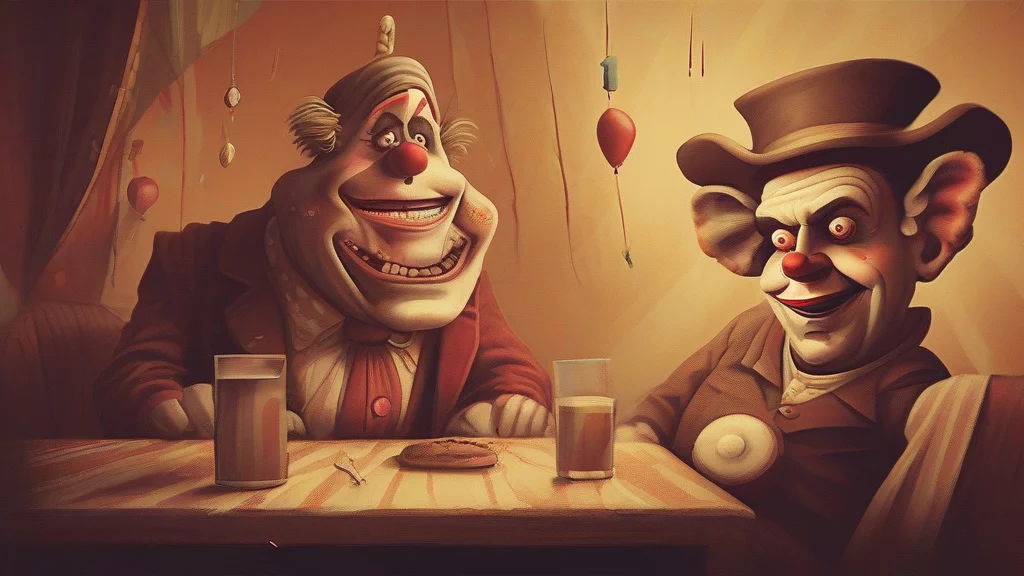
What does buffoonish mean?
Buffoonish is an adjective describing behaviour that resembles that of a buffoon: ridiculous, clownish, and absurdly foolish. It is typically applied to people whose conduct strikes observers as comically undignified — politicians posturing on television, fictional characters bumbling through their roles, or anyone whose exaggerated antics invite mockery rather than laughter with them. The word carries a distinctly negative connotation, implying contempt for a lack of seriousness, and it sits slightly above playful synonyms like 'goofy' in formality, making it a favourite of critics and journalists who want to ridicule without resorting to outright insult. It derives from 'buffoon', which entered English in the sixteenth century from French 'bouffon' and ultimately Italian 'buffone', meaning a jester. Because it captures both the comic and the contemptible in a single word, buffoonish remains a precise and useful term for describing performative foolishness.
adjectiveResembling or characteristic of a buffoon; behaving in a ridiculous, clownish, or foolishly comic manner.
- Behaving or appearing in a ridiculous, clownish, or absurdly foolish way.
"His buffoonish antics at the meeting undermined what should have been a serious discussion."
"The film's villain is less menacing than buffoonish, tripping over his own schemes."
"Critics dismissed the politician's buffoonish television appearances as a distraction from his policies."
Before it meant a fool on stage, the word behind 'buffoonish' — Italian 'buffone' — described professional jesters whose job was literally to make audiences laugh at their own absurdity.
Reviewed by Deb Chak, Editor. AI-assisted content curated by RJS Tech Solutions LLP.
Etymology of buffoonish
Buffoonish derives from 'buffoon', a noun adopted into English in the mid-to-late sixteenth century from French 'bouffon', which itself came from Italian 'buffone', meaning a jester or comic performer. The adjective suffix '-ish' was added later to produce a word meaning 'having the qualities of a buffoon'. Cognates include the French 'bouffon' and the Italian musical term 'buffo', seen in 'opera buffa'. The word has retained its mocking connotation throughout its history in English.
How buffoonish is actually used
Carries an unambiguously negative or mocking connotation — describing someone as buffoonish implies contempt for their lack of seriousness or dignity. Common in journalism and criticism when ridiculing public figures or characters. Slightly formal in register compared with 'clownish' or 'goofy'.
Easily confused with buffoonish
'Boorish' means rude and insensitive, while 'buffoonish' means comically foolish or clown-like.