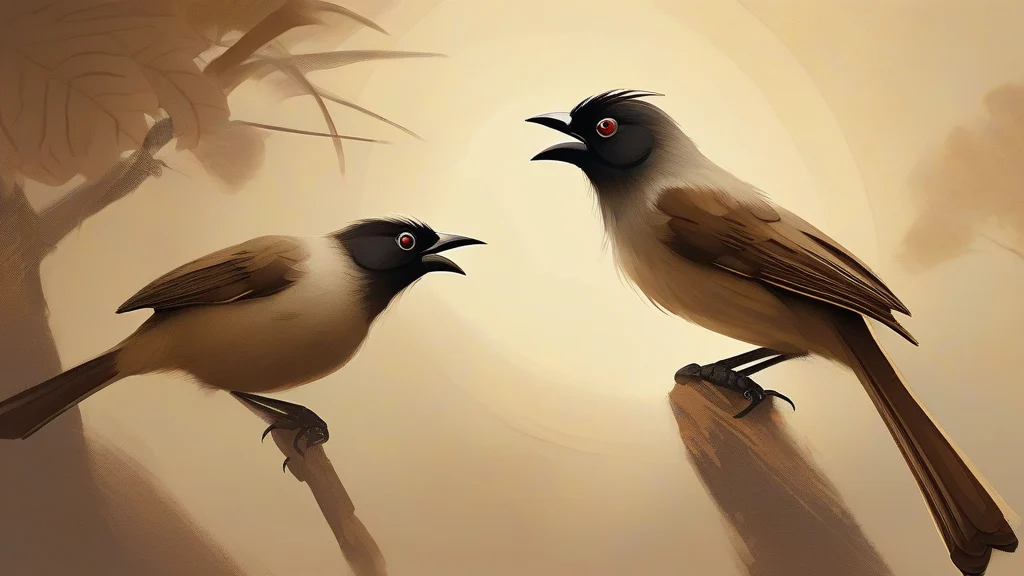
What does bulbul mean?
A bulbul is a medium-sized songbird belonging to the family Pycnonotidae, a group of roughly 150 species found across Africa, the Middle East, and southern Asia. Bulbuls generally have plain olive, brown, grey, or yellowish plumage, often set off by a crest or a splash of color around the head or vent, and they are best known for their lively, melodious, frequently repeated calls. Several species, such as the red-vented and yellow-vented bulbuls, thrive in gardens and cities and rank among the most familiar birds of South and Southeast Asia. Beyond ornithology, the bulbul holds a cherished place in Persian, Arabic, and Urdu literature, where it appears as the quintessential songster — conventionally depicted as a lovesick singer pining for the rose. The word entered English in the seventeenth century from Persian via Arabic and Turkish, and it remains a graceful, slightly exotic term that evokes warm climates, gardens, and poetic tradition.
nounA bulbul is any of numerous medium-sized songbirds of the family Pycnonotidae, native chiefly to Africa, the Middle East, and southern Asia, typically having plain plumage and a melodious song.
- Any of various songbirds of the family Pycnonotidae, found mainly in Africa, the Middle East, and South Asia, known for their pleasing, often repetitive songs.
"A bulbul sang from the mango tree as the morning mist lifted over the garden."
"A red-whiskered bulbul flitted among the hibiscus bushes, its cheerful call carrying across the courtyard."
"In classical Persian verse, the lovesick bulbul sighs for the rose through the stillness of the night."
Standard regular plural; occasionally used attributively, as in 'bulbul species'.
"At dawn the garden was loud with bulbuls calling from every tree."
The bulbul is the 'nightingale' of Persian and Urdu poetry — Hafez and Omar Khayyam praised its song centuries before most English speakers ever heard of it.
Reviewed by Deb Chak, Editor. AI-assisted content curated by RJS Tech Solutions LLP.
Etymology of bulbul
The word bulbul entered English in the early seventeenth century, borrowed ultimately from Persian bolbol, which passed into Arabic and Turkish in the same form. The bird had long been celebrated in Middle Eastern and South Asian poetry before European naturalists adopted the name. It has no true English cognates, though related borrowings appear in other European languages through Turkish and Arabic channels.
How bulbul is actually used
The word carries literary and poetic connotations, especially in South Asian and Middle Eastern writing, where the bulbul is a traditional emblem of the lover longing for the beloved (often symbolized by the rose). In everyday ornithological use it is a neutral technical term covering many species, several of which — such as the red-vented bulbul — have become familiar urban birds in parts of Asia and introduced populations elsewhere. Plural is normally bulbuls.