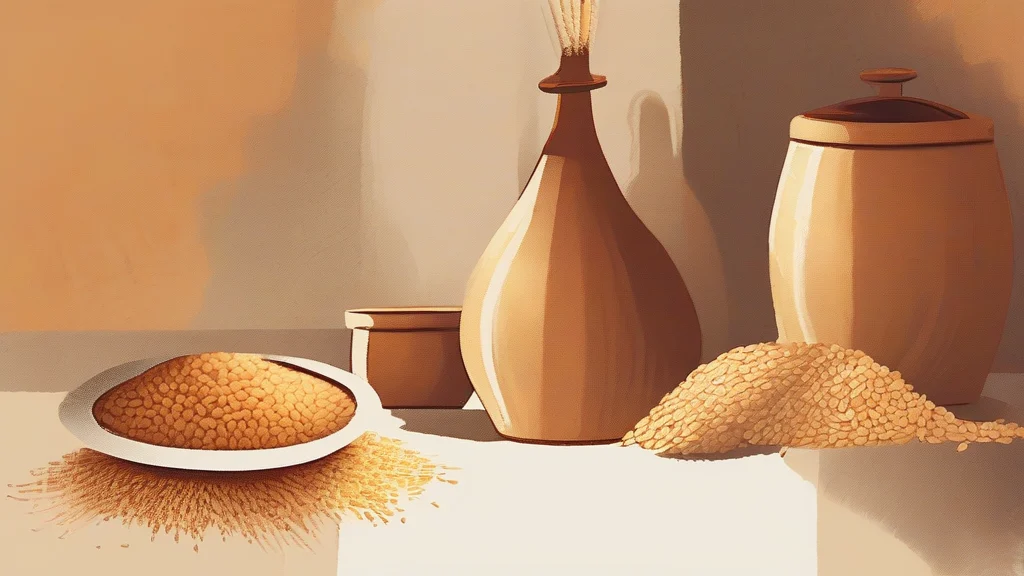
What does bulgur mean?
Bulgur is a cereal food produced from wheat kernels — most commonly durum wheat — that are parboiled, dried, and then cracked into granules of varying coarseness. Because it is precooked, bulgur needs only brief simmering or even simple soaking, making it one of the fastest whole grains to prepare. It is a cornerstone of Middle Eastern, Levantine, and Mediterranean cuisines, appearing in dishes such as tabbouleh, kibbeh, and various pilafs and salads. Nutty in flavor and pleasantly chewy in texture, it is prized for being high in fiber and protein while remaining quick and economical. In Britain it is frequently labeled 'bulgur wheat,' though 'bulgur' alone is standard elsewhere. Borrowed from Turkish, the word entered English in the seventeenth century but became widespread only as Eastern Mediterranean cooking gained popularity in the West. Today bulgur is firmly established as a pantry staple for home cooks seeking a wholesome, versatile alternative to rice.
nounA food grain made from wheat kernels that have been parboiled, dried, and cracked, used widely in Middle Eastern and Mediterranean cooking.
- A cereal food made from wheat kernels that have been boiled, dried, and cracked into coarse, medium, or fine grades.
"The tabbouleh gets its hearty texture from a generous cup of bulgur."
"For the pilaf, she toasted the bulgur in olive oil before adding the simmering broth."
"Fine-grain bulgur softens simply by soaking, which is why it works so well in tabbouleh."
Rarely pluralized; when it occurs, the plural distinguishes grades or varieties of bulgur rather than counting individual grains.
"The store stocks three bulgurs, ranging from fine to coarse."
Bulgur is so ancient it appears in the Hebrew Bible by another name — it has been feeding people across the Middle East for thousands of years, and still cooks in under twenty minutes.
Reviewed by Deb Chak, Editor. AI-assisted content curated by RJS Tech Solutions LLP.
Etymology of bulgur
Bulgur comes from Turkish, in which 'bulgur' denotes this prepared cracked wheat, and the word was borrowed into English during the seventeenth century through contact with the Ottoman world. It belongs to the broader family of culinary terms English acquired from Turkish and Persian sources alongside words like pilaf and yogurt. Long before its appearance in European languages, the food itself was a staple of Middle Eastern cookery, where parboiled and cracked wheat had been made for millennia under regional names.
How bulgur is actually used
In British English the term 'bulgur wheat' is especially common on packaging and in recipes, while American usage often says simply 'bulgur.' The word carries a wholesome, health-food connotation and appears mostly in culinary contexts rather than everyday conversation.
Easily confused with bulgur
Cracked wheat is raw crushed wheat that must be fully cooked, whereas bulgur has already been parboiled and therefore cooks much faster.
Couscous is made from semolina wheat rolled into tiny granules, while bulgur consists of parboiled, cracked whole-wheat kernels.