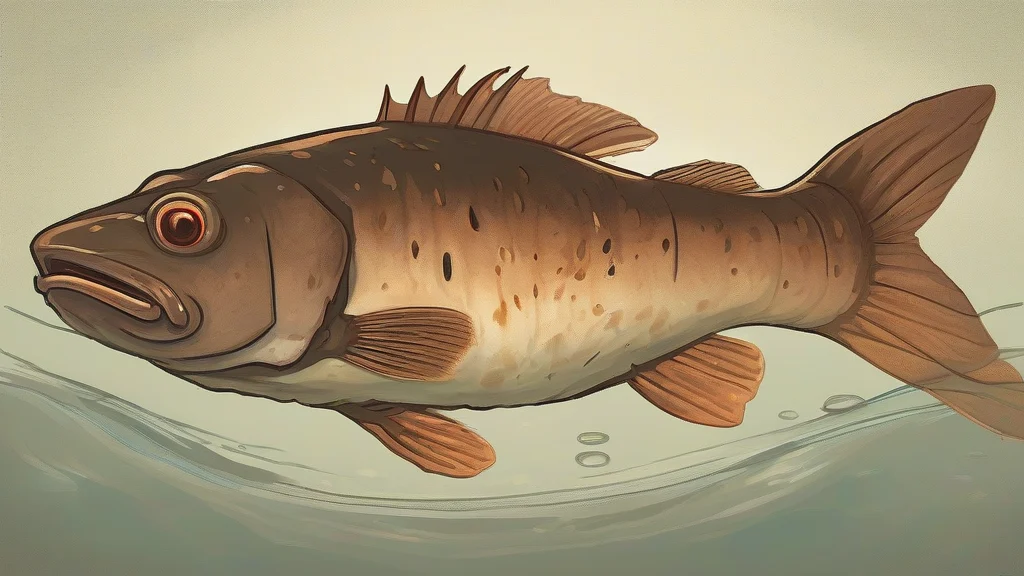
What does bullhead mean?
Bullhead is a noun with two principal uses. Most commonly, it names a freshwater fish: in North America, any of several scaleless catfish of the genus Ameiurus, recognized by their broad, flattened heads and barbels around the mouth; in Britain, it refers to the miller's thumb (Cottus gobio), a small, big-headed fish that hides beneath stones in fast-flowing streams. The name derives simply from the fish's distinctive head shape, combined with 'bull', long used to suggest something blunt or heavy. Less commonly, bullhead serves as an informal, mildly humorous label for a stubborn or thick-headed person — a figurative extension of the same idea. Anglers, naturalists, and regional writers use the word frequently, and its folk names (hornpout, mudcat) reflect deep roots in local speech. Whether describing a whiskered pond-dweller or a willful personality, bullhead carries a vivid, concrete image that makes it a memorable addition to everyday vocabulary.
A freshwater fish with a large, broad head — specifically a North American catfish (genus Ameiurus) or, in Europe, the miller's thumb (Cottus gobio).
"We caught a dozen bullheads off the dock using nothing but worms."
Which fish is meant depends on region: catfish species in North America, Cottus gobio in Britain.
Informally, a stubborn or obtusely headstrong person.
"He's a bullhead about changing his route, even when the road is closed."
Regular plural; used for multiple fish of the group or, figuratively, multiple stubborn people.
"The shallows were teeming with bullheads after sundown."
The American bullhead can survive in water so low in oxygen that most other fish would suffocate — one reason it thrives in muddy ponds where anglers least expect a catch.
Reviewed by Deb Chak, Editor. AI-assisted content curated by RJS Tech Solutions LLP.
Etymology of bullhead
Bullhead is a straightforward English compound of 'bull' and 'head', first applied to various fishes whose large, blunt heads recalled a bull's, with attestations reaching back to the early modern period. The word belongs to the broader Germanic family of 'bull' compounds — alongside bulldog, bullock, and bullfrog — all built on the Old English 'bula'. The figurative use for a stubborn person arose later by analogy with the animal's proverbial obstinacy.
Related word forms
How bullhead is actually used
In North America, 'bullhead' most often names a species of catfish, and regional folk names such as hornpout (New England) and mudcat vary by area. In Britain, the same word traditionally denotes the miller's thumb (Cottus gobio), so the fish referred to depends strongly on region. The figurative sense for a stubborn person is informal and somewhat dated.
Easily confused with bullhead
Bullheaded is an adjective describing someone stubbornly determined, whereas bullhead is a noun naming either a type of catfish (or European miller's thumb) or, figuratively, such a stubborn person.