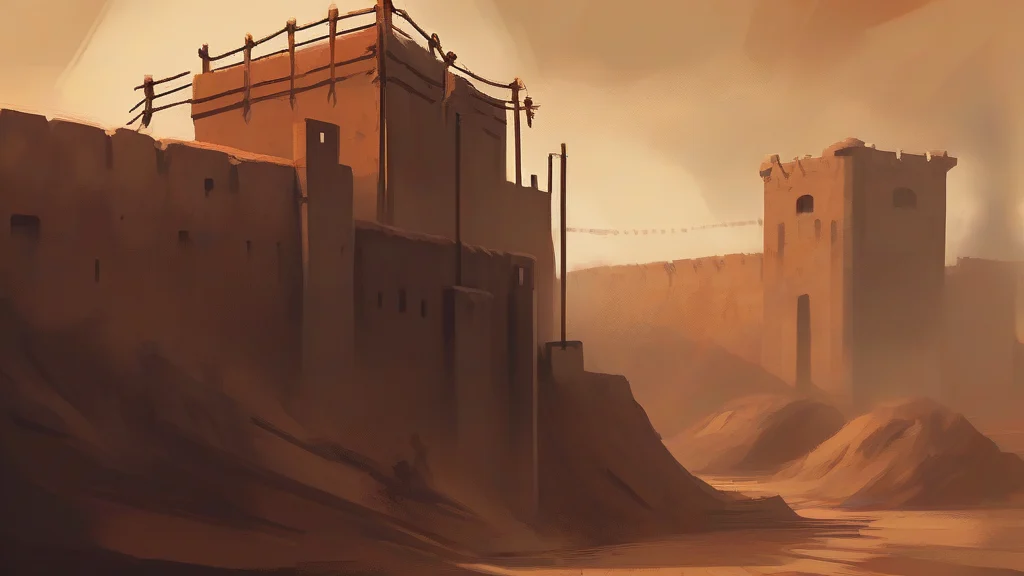
What does bulwarked mean?
'Bulwarked' is the past participle of the verb 'to bulwark,' meaning to fortify, protect, or defend something as though behind a sturdy wall. A bulwark originally denoted a physical rampart or defensive structure, so describing a person, place, or institution as bulwarked evokes an image of solid, unyielding protection. The word is used both literally — cities bulwarked by stone walls — and figuratively: a constitution bulwarked by judicial precedent, or a scientist's credibility bulwarked by years of careful research. It belongs chiefly to formal and literary registers and carries a positive connotation of resilience, security, and steadfastness. Though less common than its noun form, 'bulwarked' offers writers a vivid way to convey that something has been made impregnable against assault, criticism, or decay. Its rarity lends it weight; when it appears, it signals deliberate, emphatic defense rather than casual shelter.
Fortified or protected by, or as if by, a bulwark; strongly defended against attack or harm.
"The monastery, bulwarked by high cliffs on three sides, had never fallen to an invading army."
Most often found in literary, historical, or journalistic prose rather than everyday speech.
Past tense and past participle of 'bulwark': to fortify, protect, or defend with or as if with a bulwark.
"The framers bulwarked the new republic with a system of checks and balances."
The verb form is considerably rarer than the noun 'bulwark' and tends to appear in elevated writing.
Before it meant a wall, 'bulwark' literally meant a pile of tree trunks — Middle Dutch 'bol' (trunk) plus 'werk' (work) — and its cousin gave us the word 'boulevard.'
Reviewed by Deb Chak, Editor. AI-assisted content curated by RJS Tech Solutions LLP.
Etymology of bulwarked
'Bulwarked' derives from 'bulwark,' which entered English in the late Middle Ages from Middle Dutch 'bolwerc,' a compound of 'bol' (tree trunk or plank) and 'werck' (work or construction) — literally, a structure built from timbers. The word passed into English via Dutch maritime and military usage, where such timber defenses protected ships and fortifications. Its Germanic root also gave rise to the French 'boulevard,' which evolved from the same Dutch source through French urban fortifications before coming to mean a broad street. The verb sense of surrounding or shielding something developed naturally from the noun's defensive meaning.
Related word forms
How bulwarked is actually used
'Bulwarked' is relatively rare compared to its base noun 'bulwark' and appears mostly in formal, literary, or journalistic writing. It carries a connotation of strength and steadfastness, often used figuratively to describe institutions, traditions, or reputations defended against challenge.
Easily confused with bulwarked
'Bullwork' is not a standard English word; the correct form is 'bulwark,' and 'bulwarked' is simply its past participle.