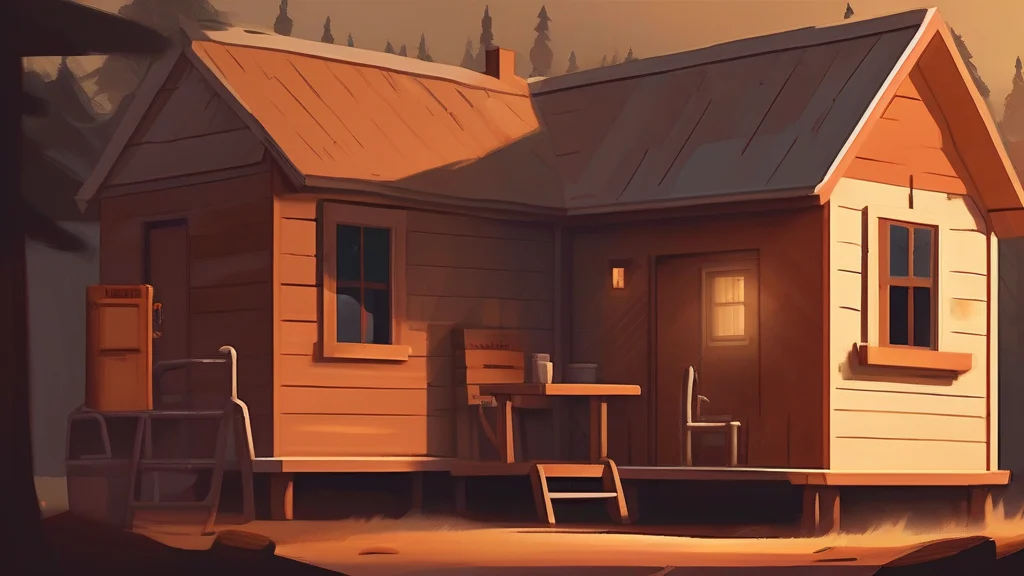
What does bunkhouse mean?
A bunkhouse is a simple building — often a single large room — fitted out with bunks to provide basic sleeping accommodation for workers or groups. The term is strongly associated with the American West, where ranches housed their cowboys in bunkhouses, but it also applies to quarters for lumberjacks, miners, railroad crews, farm labourers, and modern camp or hostel-style accommodation. Because it denotes shared, no-frills lodging rather than private rooms, the word carries connotations of hard work, camaraderie, and rough living; a night in a bunkhouse suggests early mornings, creaking frames, and conversation carried across the room. It remains in active use today for guest accommodation on working ranches and holiday farms, giving the word both a historical flavour and contemporary relevance. For writers and readers alike, 'bunkhouse' instantly conjures a specific world of rural labour and communal living.
nounA building providing simple sleeping accommodation, typically for workers such as ranch hands, lumberjacks, or campers.
- A plain building or large room furnished with bunks, used to house workers, ranch hands, miners, or groups at camps.
"The ranch hands turned in early after a long day in the saddle, each claiming a bunk in the bunkhouse."
"After the cattle drive ended, the cowboys slept three to a room in the drafty old bunkhouse."
"Volunteers staying overnight at the nature reserve were assigned beds in the converted bunkhouse behind the main lodge."
Regular plural formed by adding -s.
"Several of the old logging company's bunkhouses still stand along the river."
The word 'bunk' itself likely comes from a nautical term for a ship's sleeping berth — so every bunkhouse quietly carries a bit of sailor's slang on land.
Reviewed by Deb Chak, Editor. AI-assisted content curated by RJS Tech Solutions LLP.
Etymology of bunkhouse
Bunkhouse combines 'bunk', meaning a built-in sleeping berth, with 'house'. 'Bunk' itself appears to derive from an earlier nautical term for a ship's sleeping place, though its deeper origins are uncertain; some sources connect it to words for a bench or partitioned space aboard ship. The compound emerged in nineteenth-century North America, spreading through the language of ranching, lumber, and mining camps where such communal sleeping buildings were standard. It shares its root simply with 'bunk' and related compounds like 'bunk bed'.
How bunkhouse is actually used
The word carries a distinctly rural, working-world connotation — it evokes ranches, logging camps, and mining settlements rather than urban settings. It is common in American English, especially in Western and frontier contexts, but is understood in British English as well.
Easily confused with bunkhouse
A bunker is a fortified shelter or a sand trap on a golf course, whereas a bunkhouse is a building with bunks for sleeping.