What does bunking mean?
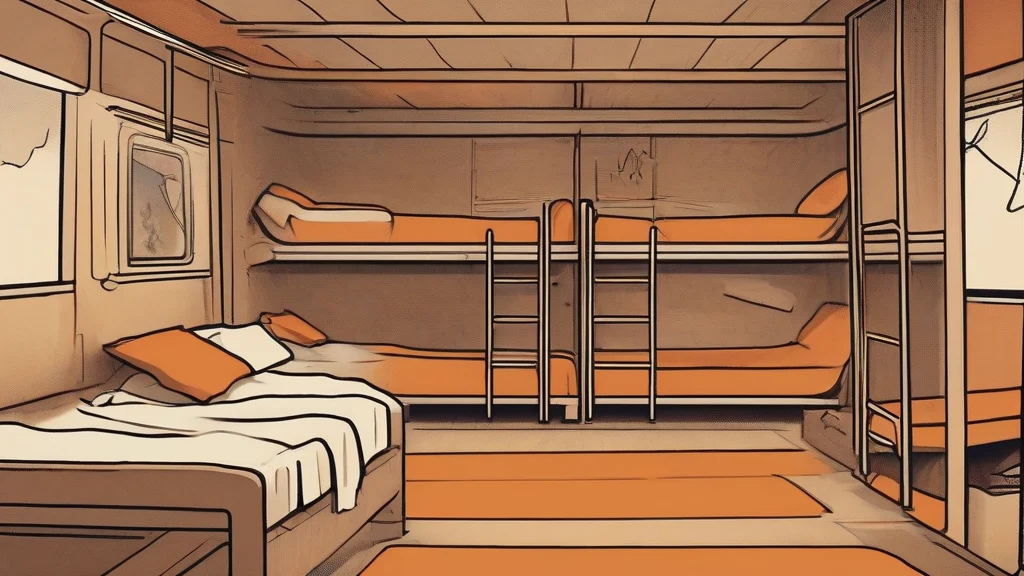
Bunking is the present participle and gerund of the verb 'bunk', and it carries two main senses. The first and oldest involves sleep: to bunk means to sleep in a bunk bed or other makeshift berth, so 'bunking' commonly describes shared sleeping arrangements at summer camps, hostels, military barracks, and college dorms — as when campers are bunking together in a cabin. The second sense, chiefly British and informal, means to skip or shirk a duty, especially school; here it almost always appears in the phrase 'bunking off'. The word carries a casual, slightly mischievous connotation in this use, evoking truancy and playful rule-breaking, while its sleeping sense feels homely and communal. Because both senses remain current on opposite sides of the Atlantic, 'bunking' is a compact example of how one short verb can branch into quite different meanings through everyday use.
Present participle of 'bunk': to sleep in a bunk or shared berth, or (British, informal) to skip or avoid school, work, or another duty.
"The scouts were bunking two to a tent for the week."
Informal in all senses; the 'skipping' sense typically appears as 'bunking off' in British usage.
The action of sleeping in bunks or shared quarters, or the act of skipping an obligation.
"Bunking with friends made the trip far cheaper than staying in hotels."
In British slang, 'bunking off' school has been a rite of rebellion for generations — and it's why 'to bunk' can mean both hitting the hay and dodging class.
Reviewed by Deb Chak, Editor. AI-assisted content curated by RJS Tech Solutions LLP.
Etymology of bunking
Bunking derives from 'bunk', a noun meaning a sleeping berth that entered English in the mid-18th century, likely from a Scottish dialect term of uncertain further origin; some accounts link it loosely to 'bunkum' (from Buncombe County, North Carolina), though that connection applies to the 'nonsense' sense of bunk rather than the sleeping one. The verb 'to bunk' developed from the noun in 19th-century America, first meaning to occupy a bunk and later, by extension, to share quarters or turn in for the night. The sense meaning 'to skip out', as in British 'bunking off', emerged later, probably from the idea of slipping away or clearing off. Related forms include 'bunkhouse', 'bunker', and 'debunk', which grew from the same family of terms.
Related word forms
How bunking is actually used
As a verb form, 'bunking' is informal in most senses. The 'skip/shirk' sense is chiefly British and usually appears in the phrase 'bunking off'; the American 'skip' equivalent is more often expressed with other verbs. The sleeping sense is common in contexts like summer camps, military barracks, hostels, and dormitories.
Easily confused with bunking
'Bunching' means gathering into a group or cluster, while 'bunking' means either sleeping in a bunk or skipping an obligation.
'Punking' means tricking or humiliating someone, whereas 'bunking' refers to sleeping in a bunk or playing truant.