What does bunsen mean?
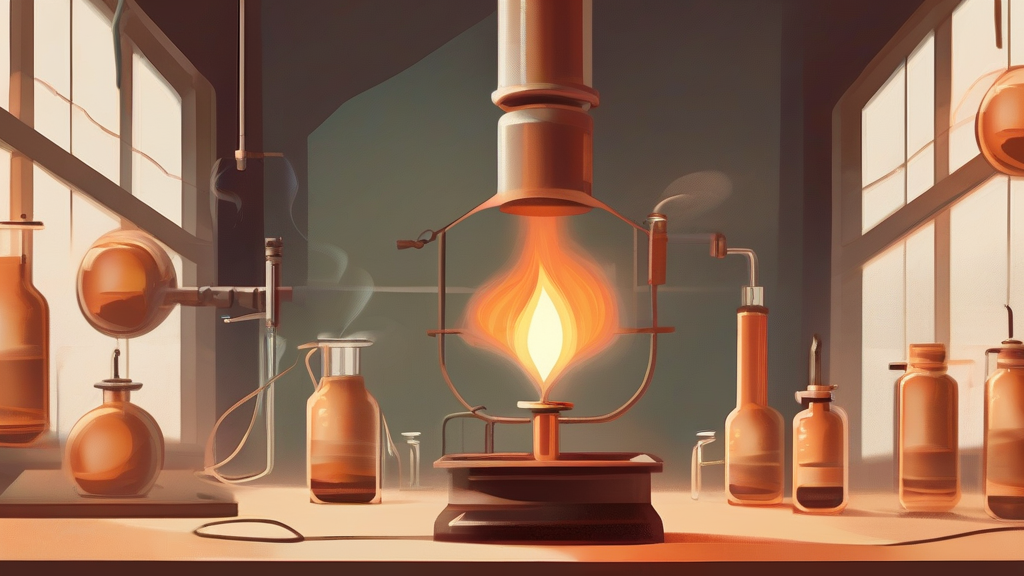
A bunsen (more fully, a Bunsen burner) is a standard piece of laboratory equipment—a gas burner designed to produce a single hot, clean, adjustable flame. Named after the German chemist Robert Bunsen, who popularized its design in the mid-nineteenth century, it works by mixing gas with air before combustion: closing the air vent yields a cool, luminous yellow flame, while opening it produces the fierce blue flame familiar from school science classes. Chemists use it for heating substances, glassworkers for softening tubing, and microbiologists for sterilizing instruments and maintaining sterile fields. In everyday speech the word rarely appears outside laboratory, classroom, or nostalgic contexts, but it remains a vivid symbol of hands-on experimental science—so much so that generations of scientists recall the smell of gas and the click of a striker as the defining sensory memory of their first chemistry lessons.
nounA Bunsen burner: a small laboratory gas burner with an adjustable air valve that produces a hot, clean flame, used for heating and sterilizing in scientific work. The word is almost always used attributively or as short for 'Bunsen burner'.
- A Bunsen burner: a gas burner with an adjustable air inlet used in laboratories for heating, sterilization, and combustion experiments.
"She adjusted the bunsen until the yellow flicker gave way to a steady blue flame."
"The students lit their bunsens before beginning the titration."
"He sterilized the loop in the hottest part of the bunsen's blue cone."
Regular plural, used mainly when referring collectively to burners in a laboratory.
"At the start of each practical class, the demonstrators checked every one of the bunsens."
Robert Bunsen never patented his famous burner—he considered his discoveries payment enough, letting labs worldwide adopt it freely.
Reviewed by Deb Chak, Editor. AI-assisted content curated by RJS Tech Solutions LLP.
Etymology of bunsen
The word derives from Robert Wilhelm Bunsen (1811–1899), the German chemist at the University of Heidelberg whose improved laboratory burner became ubiquitous after its introduction in the 1850s. Although the design was refined with the help of his technician Peter Desaga (and independently by Michael Faraday earlier), the device took Bunsen's name because he promoted its use in his influential teaching and research. Like other eponyms such as 'volt' (from Volta) and 'pasteurize' (from Pasteur), it entered English as an honorific coinage rather than through any ancient linguistic root.
How bunsen is actually used
Used almost exclusively in scientific, educational, and laboratory contexts. Often written 'Bunsen' capitalized as an eponym, though lowercase 'bunsen' is common when used alone to mean the burner. Usually appears as 'Bunsen burner' in formal writing.
Easily confused with bunsen
'Bunson' is a common misspelling; the correct spelling honors the German chemist Robert Bunsen with an 'e'.