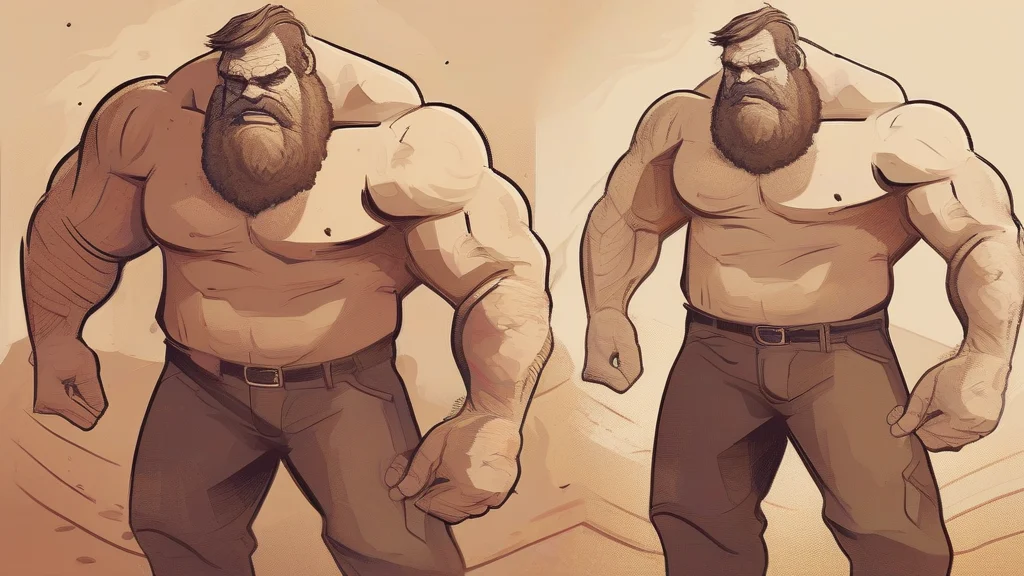
What does burly mean?
Burly is an adjective describing someone — usually a man — who is big, heavy, and powerfully built, with a strong, muscular physique. A burly figure suggests bulk and physical presence rather than mere height, and the word often carries a vivid, slightly colorful tone: writers reach for it when they want to evoke a bouncer, a lumberjack, a dockhand, or a rugby forward. It sits comfortably in both everyday speech and literary prose, pairing naturally with words like "frame," "build," and "arms." Its antonyms include "slight," "frail," and "scrawny," and its closest synonyms are "brawny," "muscular," "strapping," "hefty," and "husky." Interestingly, the word's history points in a different direction: its Old English ancestor meant stately or dignified, so the modern sense of rough physical power is a semantic shift over the centuries. Burly should not be confused with "burley," the name of a tobacco variety. Comparative and superlative forms are "burlier" and "burliest."
adjective(Of a person) large, heavy, and strongly built; muscular and robust in appearance.
- (Of a person) large, powerful, and heavily built; muscular.
"A burly dockworker hoisted the crate onto his shoulder as if it weighed nothing."
"Two burly security guards flanked the entrance to the venue."
"The novel's hero was a burly fisherman with hands like shovels and a heart to match."
"Burly" once described nobility, not muscle — in Old English it meant stately or dignified before it came to mean big and brawny.
Reviewed by Deb Chak, Editor. AI-assisted content curated by RJS Tech Solutions LLP.
Etymology of burly
Burly descends from Middle English "borlich" or "burly," which meant stately, dignified, or excellent, ultimately from an Old English source meaning noble or splendid in bearing. Over time the sense shifted from dignified grandeur to physical bulk and strength — a person imposing in stature rather than rank. The precise prehistory is uncertain, so no firm cognates can be stated with confidence; what is clear is that the word has been part of English since the medieval period, acquiring its modern bodily sense by roughly the sixteenth century.
Related word forms
How burly is actually used
Informal to neutral register; typically applied to men, often with an approving or vivid connotation of physical strength. Occasionally used figuratively or humorously for bulky objects.
Easily confused with burly
"Burley" is a variety of light-air-cured tobacco used in blends, whereas "burly" describes a person who is big and strong.