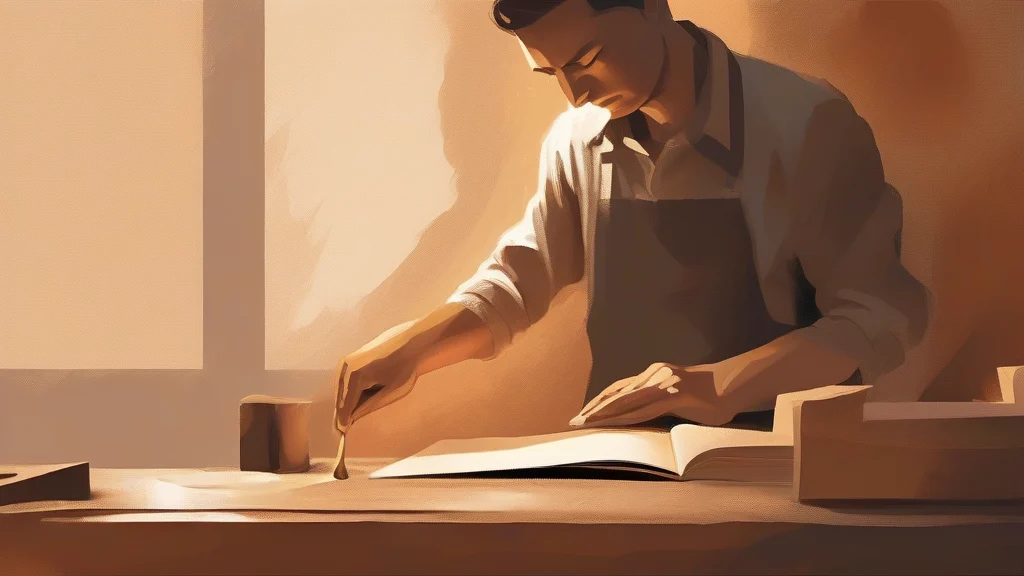
What does burnishing mean?
Burnishing refers to the process of rubbing or polishing a surface—most often metal, but also leather, clay, or stone—to render it smooth, lustrous, and reflective. Unlike painting or plating, which add material to achieve sheen, burnishing works purely through friction, compacting and smoothing the surface itself so that light reflects evenly across it. The term also enjoys a well-established figurative life: in journalism and political discourse, to say someone is 'burnishing their reputation' or 'burnishing their legacy' means they are taking deliberate steps to improve how they are perceived. This metaphorical usage sometimes carries a faintly cynical edge, implying that the improvement is cosmetic rather than substantive. In craft contexts, burnishing is prized as a traditional technique associated with quality workmanship, from armourers' workshops to bookbinders and potters. The word derives ultimately from 'brun', meaning brown or dark.
Present participle of 'burnish': to rub a surface, especially metal, to make it smooth and shiny; figuratively, to improve or enhance something's appearance or reputation.
"He spent the afternoon burnishing the bronze statue in preparation for the unveiling."
The process or result of polishing a surface by rubbing, especially in metalwork, leatherwork, or ceramics.
"The burnishing on the antique brass gave it a mirror-like depth."
To 'burnish your image' originally meant to make it brown — the word traces back through Old French to 'brun', meaning dark or brown.
Reviewed by Deb Chak, Editor. AI-assisted content curated by RJS Tech Solutions LLP.
Etymology of burnishing
Burnishing comes from the Old French verb 'burnir', a variant of 'brunir' meaning to make brown or to polish, derived from 'brun' (brown). It entered English in the late medieval period via Middle French, initially describing the polishing of metal. The root 'brun' connects it to cognates such as 'brown', 'brunette', and 'bruin', all tracing back to Germanic origins for the colour brown—an ironic history given that burnishing produces brightness.
Related word forms
How burnishing is actually used
'Burnishing' as a verb form appears chiefly in progressive constructions ('was burnishing', 'is burnishing'); the bare noun use refers mainly to the trade or craft context of metalworking, leatherwork, and ceramics. The figurative sense of enhancing a reputation is common in journalism and political commentary and carries a slightly cynical connotation of cosmetic improvement.
Easily confused with burnishing
'Garnishing' means decorating food with accompaniments, whereas 'burnishing' means polishing a surface to a shine.
'Varnishing' means applying a protective glossy coating, whereas 'burnishing' means achieving shine by friction rather than by adding a layer.