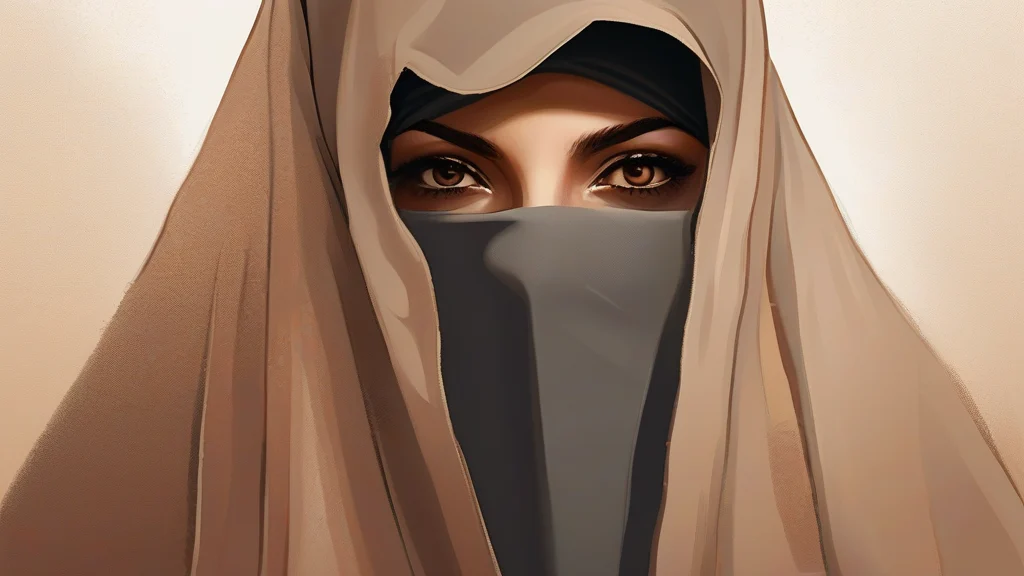
What does burqa mean?
The burqa (also spelled burka) is an enveloping outer garment worn by some Muslim women that covers the entire body and face. Its most recognizable form, common in Afghanistan, is a single piece of pleated cloth with a woven mesh grille over the eyes, allowing the wearer to see out while remaining fully concealed from view. The word entered English from Urdu, Persian, and ultimately Arabic sources in the nineteenth century. While related garments exist across the Muslim world — such as the niqab, chador, and abaya — the burqa is distinguished by being the most complete form of veiling, hiding even the eyes behind fabric or mesh. In contemporary public discourse the term carries considerable political weight: debates over wearing the burqa intersect questions of religious liberty, personal autonomy, security, and secularism, and several countries have restricted or banned its use in public spaces. For readers, understanding the precise meaning of 'burqa' helps distinguish it from other veils and appreciate why it features so prominently in discussions of culture and law.
nounA long, loose outer garment worn by some Muslim women that covers the entire body and face, including the eyes in its most concealing forms.
- A full-body veil worn by some Muslim women, covering the body and face entirely, associated especially with Afghanistan.
"In parts of southern Afghanistan, many women still wear the burqa when they go out in public."
"Under Taliban rule, women were required to wear the blue burqa whenever they left home."
"The debate over whether to outlaw the burqa has divided parliaments across several European countries."
Both 'burqas' and the unchanged 'burqa' are acceptable plurals; 'burqas' is more common in general English usage.
"Rows of colorful burqas hung in the bazaar stalls."
The word 'burqa' traveled from Persian and Arabic into English only around the mid-19th century — yet today it's one of the most politically debated words in Europe, sparking bans in several countries.
Reviewed by Deb Chak, Editor. AI-assisted content curated by RJS Tech Solutions LLP.
Etymology of burqa
The word 'burqa' comes through Urdu and Persian from Arabic, where related terms denote face coverings; it was borrowed into English during the nineteenth century as British writers described dress in South Asia and the Middle East. It belongs to a family of words for veiling garments found across languages influenced by Arabic and Persian, though exact cognate relationships are not firmly established. The spelling 'burka', reflecting transliteration from Russian-influenced sources for Central Asian dress, is also widely accepted.
How burqa is actually used
The word carries strong political and cultural connotations, particularly in debates about religious freedom, women's rights, and national identity. In everyday use it is sometimes applied loosely to any full Islamic veil, though strictly it denotes the most concealing garment. Plurals are formed as 'burqas' or occasionally kept as 'burqa'.
Easily confused with burqa
A niqab covers the face but leaves the eyes visible, while a burqa is a full-body garment that conceals the entire face, often with mesh over the eyes.
A hijab is a headscarf covering only the hair and neck, whereas a burqa envelops the whole body and face.