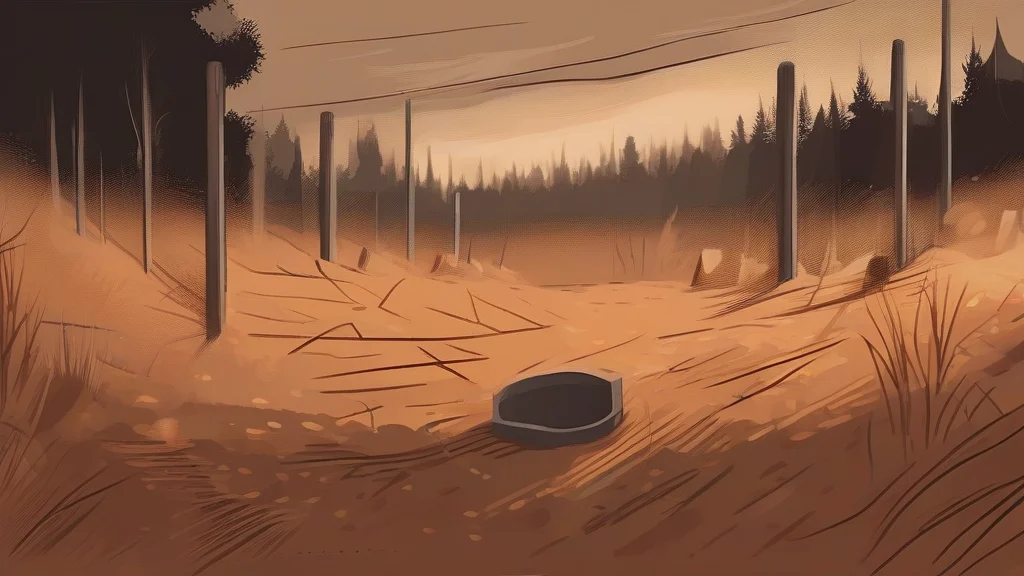
What does bury mean?
To bury is to put something beneath the surface of the ground and cover it over. Its most solemn use is the interment of the dead — a practice central to human funeral customs across cultures and millennia. But the word extends far beyond grave-digging: people bury treasure, time capsules, pipes, and secrets; snow and landslides can bury whole villages; and figuratively we bury our feelings, our mistakes, or ourselves in work or books. English also keeps several vivid idioms built on it, such as "bury the hatchet", meaning to make peace after a quarrel, and "bury the lede", meaning to obscure the most important point of a story. Derived from Old English and related to words like "borough" and "burrow", it is a plain, ancient word whose literal and figurative senses alike share one idea: placing something out of sight, beneath what lies above.
To place a person's body in the ground or a tomb as a funeral rite.
"He was buried beside his wife in the churchyard."
This sense carries a formal, solemn register.
To hide or cover something by putting it underground or under something else.
"The dog buried its bone at the bottom of the garden."
To engulf or cover completely, as with snow, sand, or rubble.
"Heavy snowfall buried the mountain roads overnight."
Figuratively, to suppress feelings, hide information, or immerse oneself entirely in an activity.
"She buried her doubts and signed the contract."
To "bury the hatchet" comes from a real practice: some Native American nations literally buried weapons to seal a peace agreement.
Reviewed by Deb Chak, Editor. AI-assisted content curated by RJS Tech Solutions LLP.
Etymology of bury
"Bury" descends from the Old English verbs "byrgan" and "burian", meaning to enclose or lay in the earth, which trace back to the Proto-Germanic root behind "*burg-" — the same source as "borough" and "burrow". This makes it an ancient native English word rather than a borrowing, with cognates in other Germanic languages such as the German "Burg" (fortress). It has been in continuous use since the earliest records of English, its core sense of placing something under the ground unchanged for over a thousand years.
Related word forms
How bury is actually used
"Bury" is neutral in register but carries solemn connotations when used for the dead, and idiomatic or figurative uses (bury the hatchet, bury the lede) are common in everyday speech and journalism. The past tense is "buried".
Easily confused with bury
"Berry" is a small edible fruit, while "bury" is a verb meaning to place something underground or hide it — they sound identical but share no meaning.