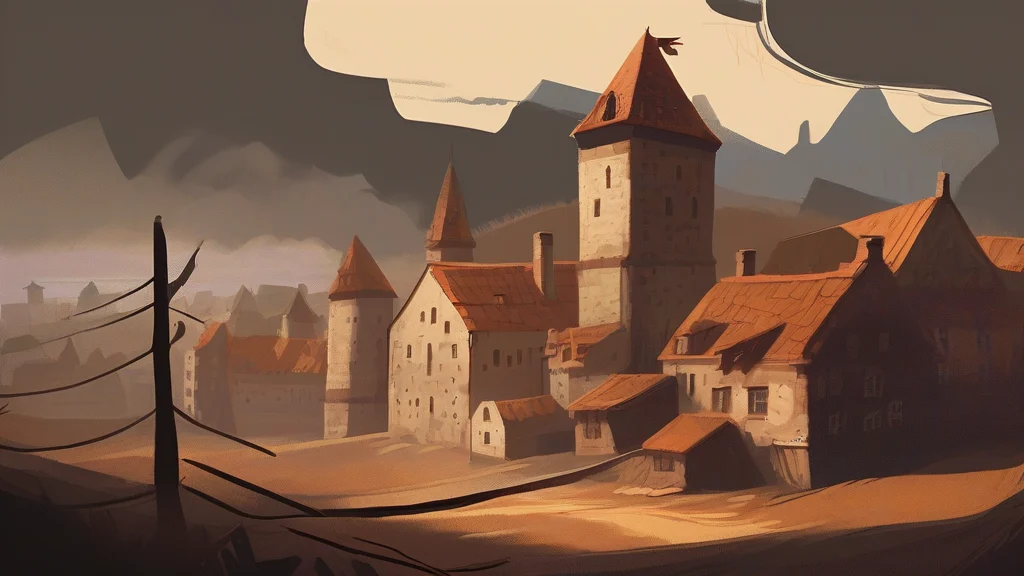
What does burg mean?
Burg is an informal noun used to describe a town or city, most commonly in North American speech and usually with the implication that the place is small, provincial, or unglamorous. Calling somewhere 'a sleepy little burg' suggests a quiet, unhurried community rather than a metropolis. The word has deep historical roots: it descends from the Old High German 'burg,' meaning a fortified place or stronghold, the same root that gives us 'borough' and 'burgh' in English place-names such as Edinburgh and Pittsburgh. In its more technical, historical sense, a burg denotes a walled or fortified medieval settlement in German-speaking Europe. Today the everyday sense is conversational rather than formal — you would use it in speech or casual writing but rarely in official documents. Its enduring presence in countless town names across America makes it a quietly fascinating piece of linguistic history embedded in the map itself.
An informal term for a city or town, particularly one viewed as small or unremarkable.
"She escaped her hometown burg the moment she turned eighteen."
Chiefly North American and informal; often used with mild affection or condescension.
A fortified medieval town or stronghold, especially in German-speaking Europe.
"The tour visited a well-preserved burg overlooking the Rhine."
Historical or technical register; less common in everyday English.
Regular plural formation.
"The novelist drew material from the small burgs scattered across the prairie."
Every American 'burg' — from Harrisburg to Gettysburg — carries a thousand-year-old German word for 'fortress' in its name.
Reviewed by Deb Chak, Editor. AI-assisted content curated by RJS Tech Solutions LLP.
Etymology of burg
Burg comes from the Old High German 'burg,' meaning a fortified enclosure or castle, which traces back through Proto-Germanic '*burgz' to the same root that produced Old English 'burh' — the ancestor of modern 'borough' and the '-bury' of many English place names. The word entered English usage both directly, in reference to German fortified towns, and through American English as a colloquial term for any town. Cognates appear throughout the Germanic languages, including Dutch 'burg' and Scandinavian 'borg.'
How burg is actually used
'Burg' is informal and slightly colloquial, often carrying a mildly affectionate or faintly dismissive tone when applied to a small American town. The sense meaning a fortified German settlement is largely historical or technical.
Easily confused with burg
'Berg' (from Dutch/German for 'mountain') refers to a hill or, as in 'iceberg,' a mass of ice, whereas 'burg' refers to a town or fortress-settlement.