What does busby mean?
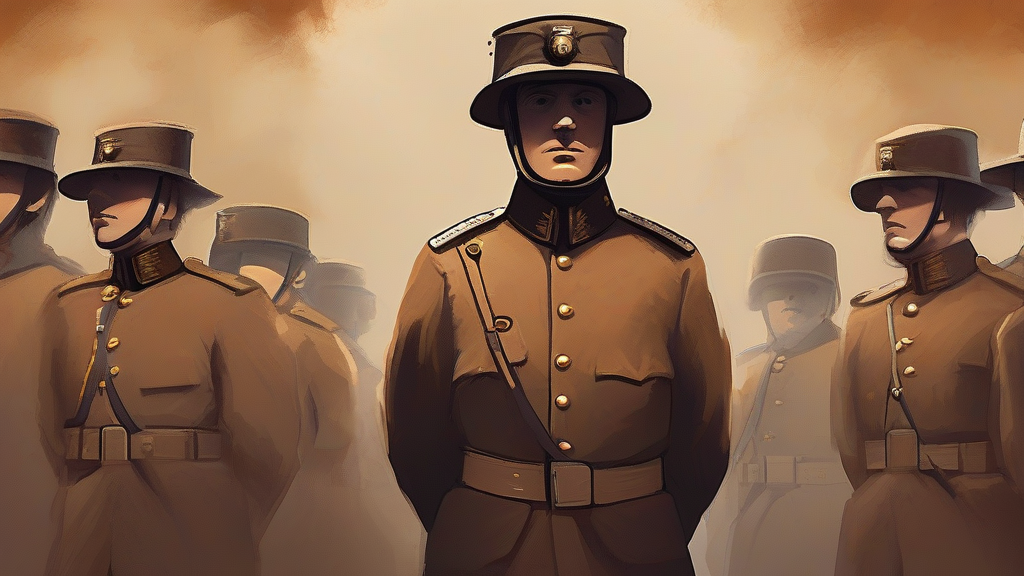
A busby is a tall, cylindrical military head-dress made of fur or trimmed with fur, usually crowned with a coloured cloth bag that hangs to one side, sometimes surmounted by a plume. It is most closely associated with European hussar and other light-cavalry regiments of the eighteenth and nineteenth centuries, and it survives today chiefly as part of ceremonial uniform — most famously among certain British Army units such as the Royal Horse Artillery. The word entered English around the late seventeenth or early eighteenth century, though its ultimate origin remains disputed, with some sources attributing it to the name of a London hatmaker. In everyday modern usage the term appears almost solely in historical writing, costume discussion, and descriptions of guard ceremonies, where the sight of soldiers in scarlet tunics and furred busbys remains a familiar pageant. Because it denotes a specific and visually distinctive object rather than an abstract idea, its connotations are those of pomp, regimental tradition, and martial display.
nounA tall fur or fur-trimmed military head-dress, typically cylindrical with a bag hanging from the top, worn chiefly by cavalry and other ceremonial regiments.
- A tall fur or fur-trimmed cylindrical military headdress, often with a hanging bag, worn by cavalry and ceremonial troops.
"The guardsman's plumed busby gleamed in the sunlight as the parade passed Buckingham Palace."
"The hussar tucked his plume into the top of his busby before mounting his horse."
"Tourists photographed the sentries, their white-plumed busbys catching the afternoon light."
Standard regular plural; occasionally seen as 'buses' in older texts, but 'busbies' is the accepted modern form.
"The squadron rode past in a row of matching busbys."
The word 'busby' may honor an 18th-century London hatter — meaning one of Britain's most iconic military hats might be named after a shopkeeper.
Reviewed by Deb Chak, Editor. AI-assisted content curated by RJS Tech Solutions LLP.
Etymology of busby
The origin of 'busby' is genuinely obscure. The word appears in English from around the late seventeenth century for a kind of military head-dress, but dictionaries differ on where it came from: one long-standing suggestion attributes it to Dr. Richard Busby, the celebrated seventeenth-century headmaster of Westminster School, while others connect it to a London hatmaker of the era, and still others point to continental military fashion without settling on a source language. What is certain is that the term became attached to the fur caps worn by hussars and other light cavalry across Europe, spreading with that style of uniform through the eighteenth and nineteenth centuries. Because no secure cognates are established, the word stands essentially alone etymologically.
How busby is actually used
Almost exclusively used in historical and military contexts, especially British and European cavalry uniforms of the 18th–19th centuries; rare outside discussions of ceremonial or period dress.
Easily confused with busby
A bearskin is a taller, broader fur cap worn by foot-guards regiments, whereas a busby is a smaller cylindrical fur hat, often with a coloured cloth bag on top.
A buskin is a knee-high boot or laced footwear of classical drama, entirely unrelated to the military fur hat called a busby.