
What does bustard mean?
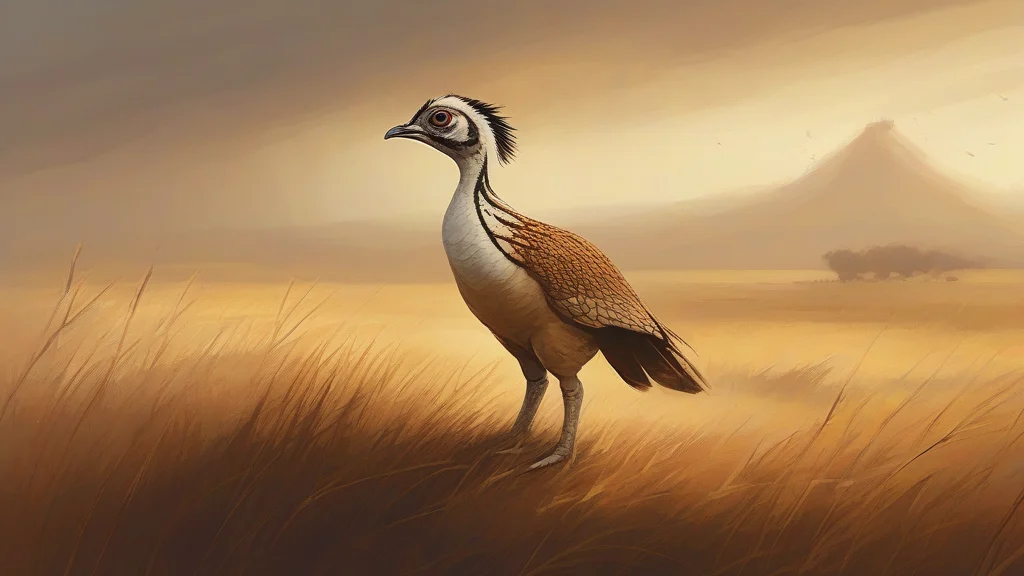
A bustard is a large, long-legged, ground-dwelling bird belonging to the family Otididae, native mainly to the grasslands, steppes, and semi-deserts of Europe, Asia, Africa, and Australia. Bustards are notable for their impressive size — the male great bustard and the African Kori bustard rank among the heaviest birds capable of sustained flight — and for their wary, terrestrial habits: they prefer walking and running to flight and nest directly on the ground. The name appears frequently in ornithology and conservation writing, since several species, including the great bustard, have suffered severe declines due to habitat loss and hunting, prompting high-profile reintroduction projects such as the one that restored the species to Britain in the early twenty-first century. Although obscure outside naturalist circles, the word is precise, well established, and instantly recognizable within discussions of wildlife and habitat conservation.
nounA large, heavy-bodied terrestrial bird of the family Otididae, found chiefly in open grassland and steppe habitats of the Old World and Australia.
- A large terrestrial bird of the family Otididae, inhabiting grasslands and steppes.
"The great bustard, one of the heaviest flying birds on earth, strides confidently across the open plain."
"The male Kori bustard can weigh up to 19 kilograms, making it among the heaviest flying animals alive today."
"Conservationists celebrated when the first wild-hatched great bustard chicks were recorded in southern England in nearly two centuries."
The standard plural simply adds -s. In scientific and conservation contexts, writers more often refer to specific species by name than to bustards collectively.
"Vast flocks of wintering bustards once gathered on the Iberian steppes."
The great bustard is one of the heaviest birds capable of true flight — males can weigh over 18 kg — and after vanishing from Britain in 1832 it was successfully reintroduced there starting in 2004.
Reviewed by Deb Chak, Editor. AI-assisted content curated by RJS Tech Solutions LLP.
Where does bustard come from?
The word "bustard" entered English in the fifteenth century, likely borrowed from Old French "bistarde" or "oustarde." Its deeper origin is debated: the most widely cited explanation traces it to the Latin phrase "avis tarda," meaning "slow bird," a name used by Pliny the Elder, which would make it a distant relative of English words like "tardy" and "retard." However, some scholars consider this Latin derivation itself uncertain or folk-etymological, so the exact root cannot be stated with complete confidence.
Related word forms
How bustard is actually used
The word is used almost exclusively in ornithological, conservation, and natural-history contexts. It carries no figurative meaning in modern English, though its unfortunate phonetic resemblance to "bastard" has occasionally made it a source of schoolboy humor; this is purely coincidental and unrelated etymologically.
Easily confused with bustard
A bastard is a person born to parents who are not married, while a bustard is a large ground-dwelling bird of open plains.