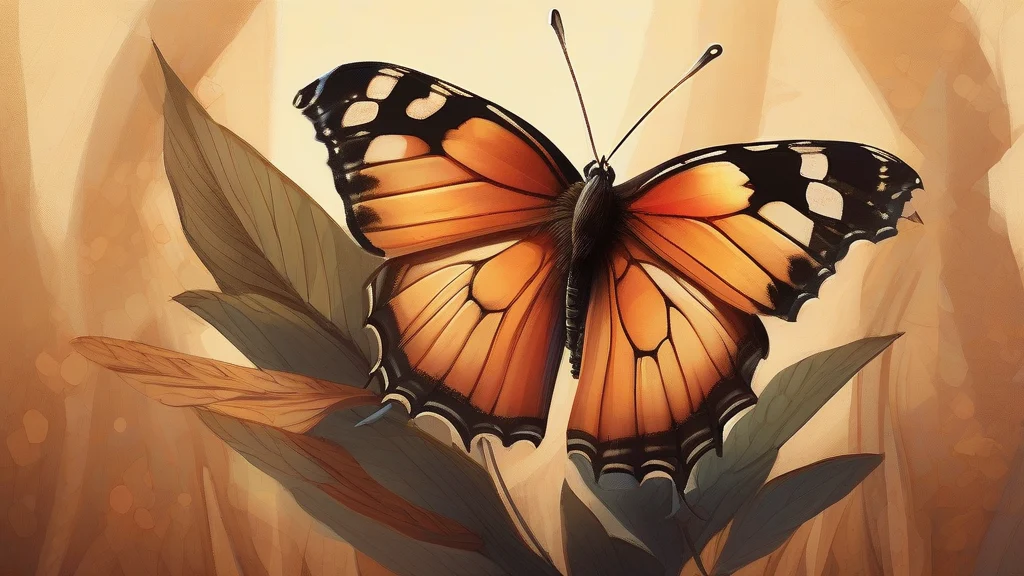
What does butterfly mean?
A butterfly is an insect belonging to the order Lepidoptera, distinguished by two pairs of large, often vividly colored wings covered in microscopic scales, slender bodies, and antennae ending in small clubs. Unlike most moths, butterflies are typically active during daylight hours, feeding on flower nectar through a long, coiled proboscis. The word carries rich figurative weight in English: a 'social butterfly' describes someone who flits charmingly between people and gatherings without settling anywhere, while 'butterflies in one's stomach' evokes the fluttering sensation of nerves or anticipation. In sport, 'the butterfly' names a graceful yet grueling swimming stroke, and chaos theory borrowed the insect for its famous 'butterfly effect,' in which minute changes can cascade into enormous consequences. Cultures worldwide associate the butterfly with transformation, thanks to its striking metamorphosis from caterpillar to winged adult — a life cycle that has made it an enduring symbol of change, beauty, and renewal.
An insect of the order Lepidoptera characterized by two pairs of large, often brightly colored scaled wings, club-tipped antennae, and daytime flight.
"A swallowtail butterfly settled on the buddleia in full sunlight."
Figuratively, 'butterfly' denotes a lighthearted, flighty person — especially in the phrase 'social butterfly' — and the plural appears in 'butterflies in my stomach' for nervousness.
To split a food item such as meat, poultry, fish, or shrimp nearly in half and open it out flat before cooking.
"The recipe calls for the leg of lamb to be butterflied so it roasts evenly."
Chiefly used in culinary contexts, usually in the passive ('to be butterflied').
Regular plural formed by adding -es because the word ends in a vowel sound followed by /z/-like 'fly' spelling; note that 'butterflies' is also used metaphorically for feelings of nervousness.
"Every spring, the meadow fills with butterflies."
The word 'butterfly' likely comes from an old belief — or a joke — that these insects stole butter, and the 'butterfly effect' shows how a single flap of its wings can supposedly alter the course of history.
Reviewed by Deb Chak, Editor. AI-assisted content curated by RJS Tech Solutions LLP.
Etymology of butterfly
The word 'butterfly' derives from Old English 'buttorfleoge,' a compound of 'buttor-' (butter) and 'fleoge' (fly). The exact reason for the butter connection is uncertain; suggested explanations include a folk belief that the insects stole butter, or that yellowish species such as the brimstone reminded people of the color of butter. The word has cognate forms in other Germanic languages, such as Dutch 'botervlieg' and German dialectal 'Butterfliege,' though standard modern German instead uses 'Schmetterling.' It has been in continuous English use since the Old English period.
Related word forms
How butterfly is actually used
The plural 'butterflies' also appears figuratively in the idiom 'butterflies in my stomach,' meaning nervous excitement. As a verb (chiefly culinary), 'to butterfly' means to split a piece of meat or shrimp open flat.
Easily confused with butterfly
Moths are closely related but generally fly at night, rest with wings spread or tented, and lack the clubbed antennae that characterize butterflies.