What does butting mean?
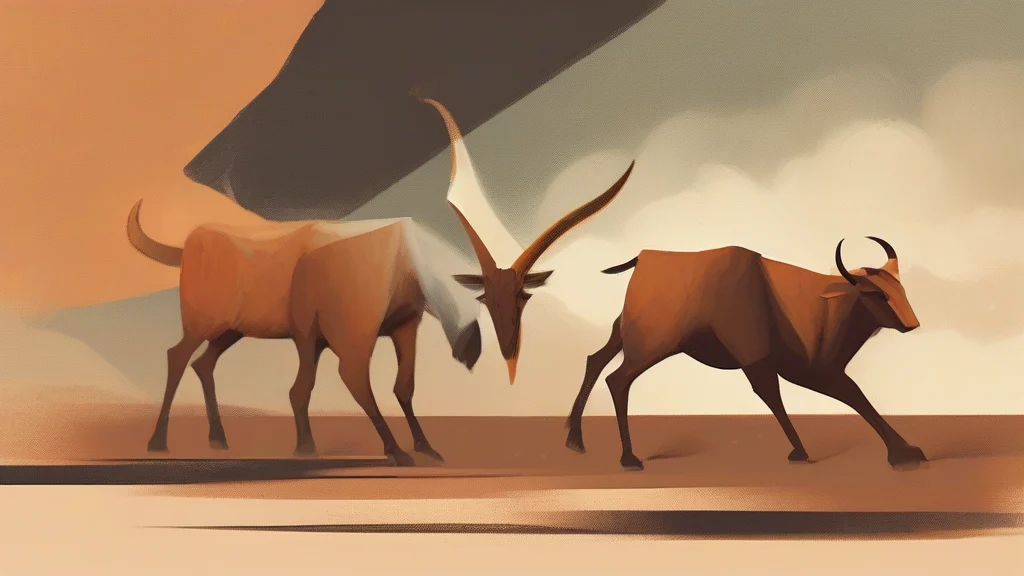
Butting is the present participle of the verb 'butt', which has two principal uses: a physical one and a social one. Physically, butting describes the act of striking or shoving something with the head or horns — the characteristic behaviour of goats, rams, and cattle, whether in play, dominance contests, or defence. Socially, butting appears most often in the phrase 'butting in', where it means intruding uninvited into a conversation or someone else's business, and carries a distinctly negative connotation of tactless interference. A related phrase, 'butting heads', describes people clashing through argument or stubborn disagreement, echoing the image of animals locking horns. The word derives ultimately from Old French 'boter', meaning to strike or push. Because its physical and figurative senses are so closely linked by the shared image of a head thrust forward, butting is a vivid, economical way to describe both animal behaviour and human friction.
verbThe present participle and gerund of the verb 'butt': to strike or push something with the head or horns, or to intrude into a conversation or situation.
- Striking or pushing with the head or horns, as goats, sheep, or cattle do.
- Intruding or interfering in a conversation, activity, or affair (chiefly in the phrase 'butting in').
"The young rams were butting each other across the hillside."
"The billy goat kept butting the fence post until it wobbled loose."
"I wish you'd stop butting into conversations that don't concern you."
Goats have been literally butting heads for millions of years — but when humans do it, they're usually just interrupting each other.
Reviewed by Deb Chak, Editor. AI-assisted content curated by RJS Tech Solutions LLP.
Etymology of butting
The verb 'butt', from which 'butting' derives, comes from Old French 'boter' (later 'bouter'), meaning to strike, push, or thrust, itself likely of Germanic origin. It entered English in the medieval period and originally described blows generally before becoming strongly associated with strikes made with the head or horns, as in horned livestock. Cognates from the same French root include words like 'buttress', 'button', and 'bouts', all reflecting notions of pushing, thrusting, or contact.
How butting is actually used
As a verb form, 'butting' is most familiar from two fixed phrases: 'butting in' (intruding rudely) and 'butting heads' (clashing or arguing). In animal contexts it is neutral and descriptive; in human contexts, especially social ones, it usually carries a mildly negative connotation of unwanted interference.
Easily confused with butting
'Putting' means placing something somewhere (or in golf, hitting a ball on the green), while 'butting' means striking with the head or horns or intruding into a situation.
'Cutting' means dividing or severing something with a blade, whereas 'butting' involves striking or pushing rather than slicing.