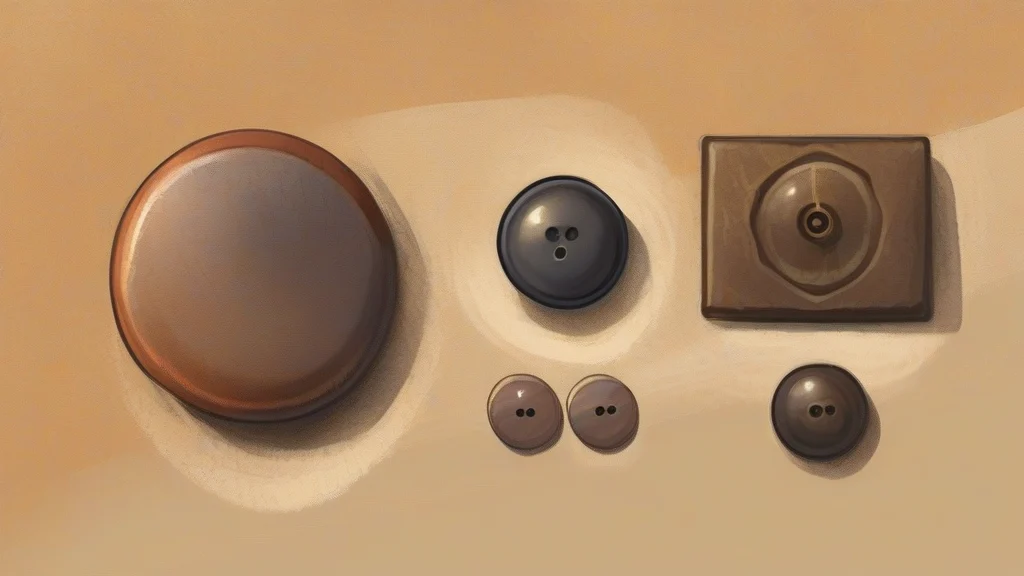
What does button mean?
A button is a small, usually round object used either as a fastener or as a control. In clothing, it is a disc — commonly made of plastic, metal, shell, or wood — sewn to one edge of a garment and slipped through a slit called a buttonhole on the other edge, holding the garment closed. The word also names any small raised control that is pressed to operate a device: the buttons of a keyboard, a lift panel, a television remote, or a computer interface, where a clickable button triggers an action. Figuratively, English has built several idioms around it: 'on the button' means precisely correct or exactly on time, while 'button up' can describe both fastening clothing and completing a task thoroughly. As a verb, to button is to close a garment by fastening its buttons. The word derives from Old French 'bouton', originally meaning a bud, reflecting the bud-like shape of early buttons. It is a neutral, everyday word found across all registers of modern English.
A small disc or knob, typically of plastic, metal, or shell, sewn onto a garment and passed through a buttonhole to fasten it; also a small control that is pressed to activate or operate a device.
"She lost a button from her cardigan and had to replace it."
In American English, 'button' also refers to a small round badge pinned to clothing.
To fasten a garment with buttons; to pass a button through a buttonhole.
"He buttoned his coat before stepping out into the snow."
Standard plural; used when referring to more than one button, whether fasteners or controls.
"The tailor kept a jar full of spare buttons on his workbench."
The word 'button' comes from Old French 'bouton', meaning 'bud' — because early buttons were literally shaped like little plant buds.
Reviewed by Deb Chak, Editor. AI-assisted content curated by RJS Tech Solutions LLP.
Etymology of button
Button entered Middle English from Old French 'bouton', meaning 'bud' or 'knot', derived from 'bouter', meaning 'to thrust or push'. Early buttons were indeed shaped like buds, which explains the original sense. The word has cognates in other Romance languages descended from the same Old French root, such as French 'bouton' itself. Its use expanded from clothing fasteners to mechanical and electronic controls as technology developed.
Related word forms
How button is actually used
As a noun, 'button' is neutral in register and common in everyday speech. The figurative phrase 'on the button' means exactly on time or precisely right. In computing contexts, buttons are interactive elements users click. The verb form is standard but slightly less common than phrasal alternatives like 'button up'.
Easily confused with button
A buttonhole is the slit a button passes through, not the button itself.