What does buttress mean?
A buttress is a structure — usually of brick or stone — built against a wall to give it extra strength, absorbing the sideways thrust that would otherwise cause tall buildings to lean or collapse. The term is most famously associated with Gothic cathedrals, where flying buttresses made it possible to build soaring walls pierced by vast stained-glass windows. Beyond architecture, the word has taken on a productive figurative life: to buttress an argument is to shore it up with evidence, and governments may buttress an economy with subsidies or regulation. Both noun and verb are fully standard in British and American English, and neither feels formal or old-fashioned; journalists and lawyers reach for 'to buttress' whenever they want to convey firm, structural support. Its etymology traces back through Old French to Latin roots meaning 'to push against,' which neatly captures what the word does in every sense.
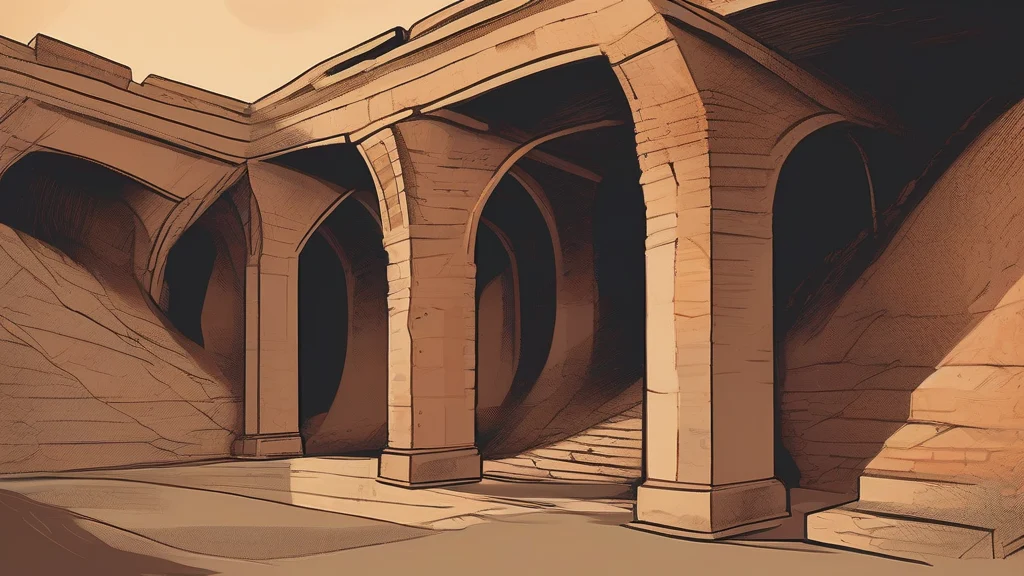
A projecting structure of masonry or other material built against a wall to support or reinforce it, especially one resisting the lateral thrust of an arch or roof.
"Massive corner buttresses braced the tower on all four sides."
In architectural contexts, 'flying buttress' refers specifically to a detached arched support typical of Gothic cathedrals.
To support, strengthen, or reinforce something, either physically (a wall or structure) or figuratively (an argument, institution, or economy).
"The new evidence served to buttress the prosecution's case."
The plural adds '-es' because the base word ends in 's'; pronounced /ˈbʌtrɪz/.
"Notre-Dame de Paris is ringed by elegant flying buttresses."
Flying buttresses were medieval engineering's greatest cheat code — they let cathedrals grow impossibly tall by holding their walls up from the outside.
Reviewed by Deb Chak, Editor. AI-assisted content curated by RJS Tech Solutions LLP.
Etymology of buttress
Buttress entered English in the Middle English period from Old French 'boteraz', derived from 'boter' or 'bouter', meaning 'to push or thrust against'. This French verb ultimately stems from a Germanic root (Frankish *bōtan) related to pushing and striking, which also gave English the words 'butt' and 'button'. So although buttresses feel quintessentially Gothic and European, the word itself arrived with Norman French builders and reflects Germanic origins filtered through French.
Related word forms
How buttress is actually used
Both noun and verb uses are standard and unmarked. The verb form often appears in political, legal, and journalistic writing ('to buttress a claim', 'to buttress the economy'). In architecture, 'buttress' is a precise technical term, with 'flying buttress' being the best-known variety — a detached arch that transmits roof thrust over an aisle to a freestanding pier. The word carries a connotation of solid, dependable reinforcement rather than decoration.
Easily confused with buttress
A butte is an isolated flat-topped hill with steep sides in the American West, whereas a buttress is a supporting architectural structure.
A bracket is a small support fixed under a shelf or projection, while a buttress is typically a large external structure supporting a whole wall.