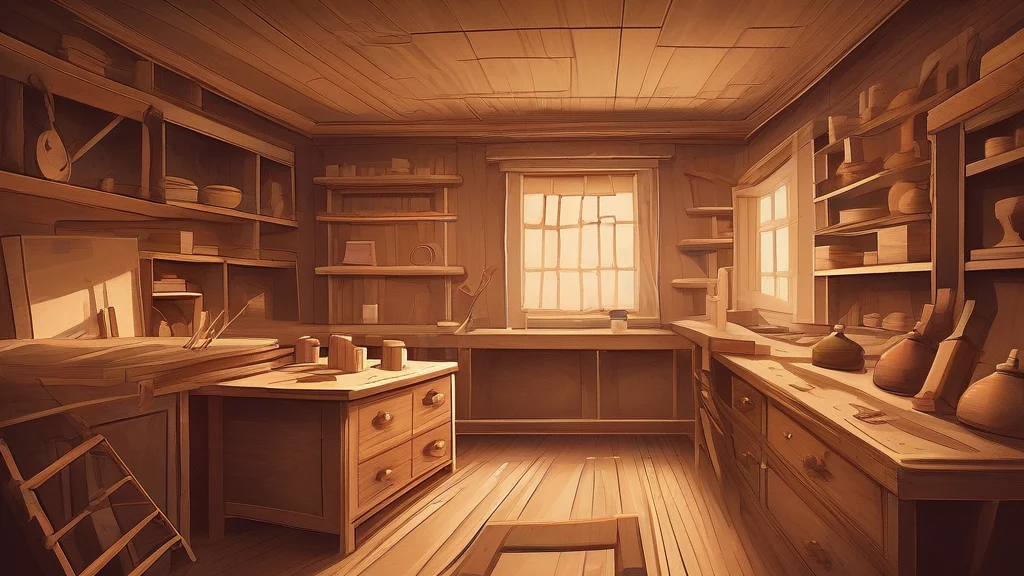
What does cabinetmaking mean?
Cabinetmaking is the craft and trade of making fine furniture, particularly wooden cabinets, chests, desks, and other case pieces. It sits within the wider world of woodworking but is distinguished by its emphasis on precision, refined joinery, and careful finishing — the hallmarks of furniture built to last generations rather than rough structural carpentry. A practitioner is called a cabinetmaker. The term appears in discussions of traditional trades, apprenticeships, craft schools, and furniture history: one might speak of learning cabinetmaking, admiring fine cabinetmaking, or studying the cabinetmaking traditions of a particular era or region. Because it denotes an activity or discipline rather than a countable object, it is used as an uncountable noun. The word carries strongly positive connotations of skill, patience, and craftsmanship, evoking the image of a workshop where hand tools, hardwoods, and meticulous attention to detail come together in the service of beautiful, functional objects.
nounThe craft or trade of making fine furniture, especially wooden cabinets, chests, and case furniture, typically with careful joinery and refined finishing.
- The craft, art, or trade of making fine wooden furniture and cabinets.
- The work or products produced by a cabinetmaker; the practice of cabinetmaking as an occupation.
"After retiring from teaching, he took up cabinetmaking and filled his house with handcrafted bookcases."
"She apprenticed for five years to master the delicate art of cabinetmaking."
"The museum's exhibition traces the history of American cabinetmaking from the eighteenth century onward."
"His grandfather earned a living through cabinetmaking, crafting desks and wardrobes by hand."
Rarely used; cabinetmaking is almost always treated as uncountable. When a plural form is needed, speakers usually rephrase using "pieces of cabinetmaking" or refer to specific works.
"The gallery displayed cabinetmakings from several centuries of European craftsmanship."
The word "cabinet" once meant a small private room — so cabinetmakers were literally the people who furnished your most secret space.
Reviewed by Deb Chak, Editor. AI-assisted content curated by RJS Tech Solutions LLP.
Etymology of cabinetmaking
Cabinetmaking derives from "cabinet," which entered English from French in the sixteenth century, ultimately tracing back through Old French "cabinet" (a small room or private chamber) to Medieval Latin "cavum" via "cabin," meaning a hollow or enclosure. As "cabinet" came to mean a piece of enclosed furniture, the compound "cabinetmaking" formed naturally in English to name the trade of building such pieces, with "cabinetmaker" attested from around the seventeenth century. Related words sharing this lineage include "cabinet" itself, "cabin," and, more distantly, "cabaret."
Related word forms
How cabinetmaking is actually used
Cabinetmaking is an uncountable noun referring to the activity or trade rather than individual objects. It carries connotations of skilled craftsmanship and traditional woodworking, often implying a higher level of finish and precision than general carpentry. It is a neutral, slightly formal term common in discussions of trades, craft education, and furniture history.
Easily confused with cabinetmaking
Carpentry is the broader trade of building structures from wood (framing, roofing, fitting), whereas cabinetmaking is a finer specialty focused on furniture and cabinets.
Joinery refers specifically to the craft of joining pieces of wood without nails, while cabinetmaking encompasses the whole process of designing and making furniture, of which joinery is one part.