What does cabaret mean?
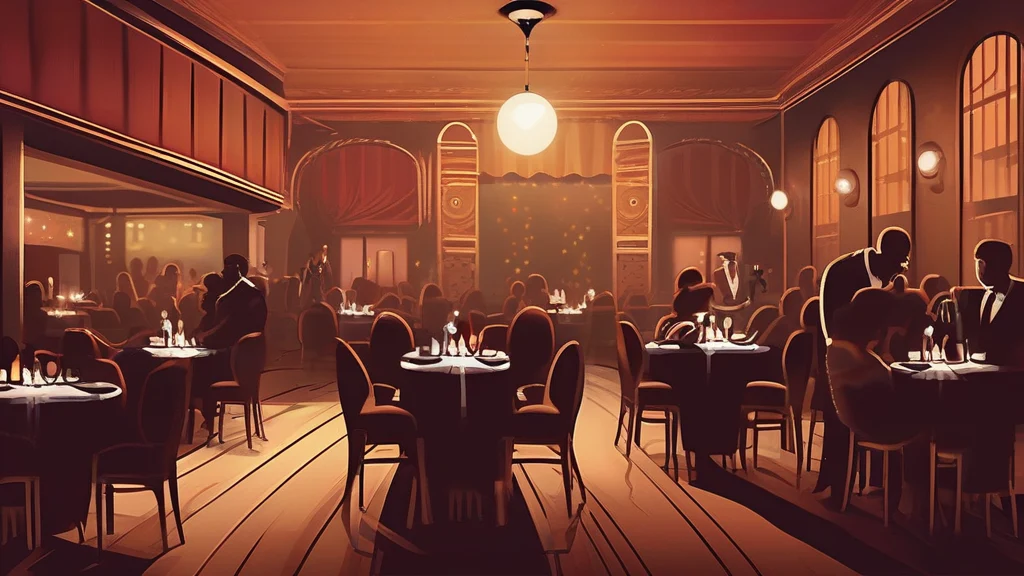
A cabaret is a form of live entertainment — typically featuring singing, dancing, music, or comedy — performed in a restaurant, club, or similar venue where the audience watches from tables while dining or drinking. By extension, the word also names the venue itself: a nightclub devoted to this kind of intimate, table-side performance. Cabaret emerged as a distinct cultural institution in late nineteenth-century France, most famously in Paris, where venues combined food, wine, and edgy artistic performance, and it flourished again in Weimar-era Berlin with a reputation for satire and daring content. Today the term evokes glamour and intimacy, though it can also suggest something slightly old-fashioned or theatrical. Performers who specialize in this genre are called cabaret singers or cabaret artists, and events are often described simply as 'a cabaret.' The word remains widely used for revue-style shows worldwide.
nounEntertainment — typically music, song, dance, or comedy — performed in a restaurant or nightclub while the audience sits at tables eating and drinking; also, such a restaurant or nightclub itself.
- Live entertainment — music, song, dance, or comedy — staged in a restaurant or nightclub while patrons dine at tables
- A restaurant or nightclub that provides such entertainment
"The couple spent the evening at a cabaret on the Left Bank, sipping wine between acts."
"Her smoky voice made her the star of every Parisian cabaret."
"The troupe's new cabaret blends jazz standards with biting political satire."
The plural refers either to multiple shows or to multiple venues offering this kind of entertainment.
"Berlin's cabarets of the 1920s were renowned for their wit and audacity."
The word 'cabaret' literally traces back to a small tavern where drinkers were served — before it came to mean the show itself.
Reviewed by Deb Chak, Editor. AI-assisted content curated by RJS Tech Solutions LLP.
Etymology of cabaret
The word 'cabaret' entered English in the mid-seventeenth century from French, where it originally meant a small tavern or drinking establishment. Its deeper origin is debated: it may derive from 'camberete,' an Old North French diminutive related to Middle Dutch 'cambrette' (small room), which would connect it to the Germanic root behind 'chamber' — making 'cabinet' and 'cabin' distant relatives. Over time the French word shifted from naming the tavern itself to describing the entertainment offered there, a sense cemented by the famous Parisian venues of the 1880s such as Le Chat Noir and Moulin Rouge.
How cabaret is actually used
Cabaret is used as both a countable noun ('a cabaret') and an uncountable noun referring to the style of entertainment itself. It carries connotations of glamour, intimacy, and sometimes risqué or satirical performance, especially in reference to early-20th-century Berlin and Paris. The related adjective 'cabaret-style' describes seating arranged around tables facing a stage.
Easily confused with cabaret
A buffet is a self-service meal or sideboard, whereas a cabaret is entertainment (or its venue) presented to seated diners.
Caboodle appears only in the phrase 'kit and caboodle' meaning the whole lot, and has nothing to do with nightclub entertainment.