What does cableway mean?
A cableway is a transport system built around one or more suspended cables, strung between towers or anchor points, along which a carriage, bucket, or carrier moves goods or people. The term arises most often in engineering contexts: mining operations used cableways to haul ore down mountainsides, forestry companies moved timber across ravines, and large construction projects — most famously the Hoover Dam — relied on them to swing heavy loads into place before modern cranes and helicopters made such work easier. Cableways also serve passengers, in forms overlapping with ropeways, aerial trams, and ski lifts. The word has an industrial, technical register and rarely appears in casual conversation, though it remains standard vocabulary in mining, civil engineering, and mountain-transport literature. Its usefulness lies in precision: where "lift" or "tram" suggests passenger service, "cableway" can denote either, and historically it leans toward freight. It is a compound of "cable" and "way," plainly describing what it is — literally a way made of cable.
nounA system of cables, often suspended between towers or anchored points, used to transport people or materials — typically in a suspended carriage, bucket, or carrier — across difficult or elevated terrain.
- A suspended cable transport system for carrying materials such as ore, timber, or construction supplies across rough or steep terrain.
- An aerial passenger-carrying cable transport, such as a ski-lift-style or tram-style installation.
"The miners hauled ore up the mountainside by cableway long before any road reached the site."
"Aerial cableways carried freshly cut timber down slopes too steep for trucks to climb."
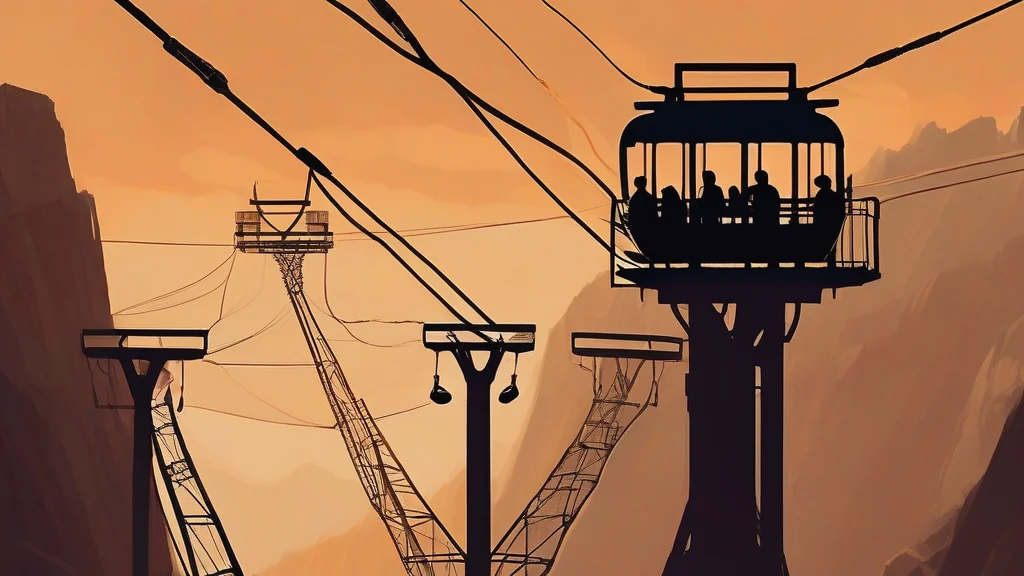
"Passengers rode the cableway to the summit station, watching the valley fall away beneath them."
Standard plural; used when referring to multiple installations, often within a single mine or construction project.
"Several cableways crisscrossed the quarry, each serving a different terrace."
When the Hoover Dam was built in the 1930s, giant cableways did much of the heavy lifting, swinging buckets of concrete out over Black Canyon — decades before helicopters could have done the job.
Reviewed by Deb Chak, Editor. AI-assisted content curated by RJS Tech Solutions LLP.
Etymology of cableway
Cableway is an English compound formed transparently from "cable," borrowed into Middle English from Old North French, ultimately traceable to late Latin roots associated with rope and halters, combined with "way," from Old English "weg." The compound arose in the nineteenth century alongside the industrial technology it names, as engineers developed suspended-cable systems for hauling ore and timber in mountainous terrain. It belongs to a family of transport coinages using "-way," including tramway, railway, and roadway, all built on the same native Germanic element.
How cableway is actually used
"Cableway" is a technical term, encountered mainly in engineering, mining, forestry, and construction contexts rather than everyday speech. It carries a practical, industrial connotation and appears more often in British technical writing than casual American usage, where "ropeway" or "aerial tramway" may be preferred for passenger systems. It is almost always countable and frequently preceded by modifiers indicating purpose, as in "material cableway" or "passenger cableway."
Easily confused with cableway
A cableway transports loads in a hanging carriage along suspended cables, while a catwalk is a narrow elevated walkway a person walks along directly.